

What Is Shift Left Testing and How It Redefines Quality
Shift-left testing is all about moving quality checks from the very end of the software development process to the very beginning. It’s a simple idea with huge implications. Instead of waiting for a final, frantic QA phase, teams build testing into every single stage, starting from the initial design and the first line of code.
This whole approach is about preventing defects in the first place, not just finding them after the fact.
Understanding the Shift Left Testing Philosophy
Imagine you're building a skyscraper. Would you wait until the 50th floor is built to check if the foundation is solid? Of course not. You'd test the hell out of that foundation before a single beam for the upper levels goes into place. That’s the core idea behind what is shift left testing.

Traditionally, testing was its own separate world, a distinct phase that happened way over on the "right" side of the development timeline—long after all the code was written. This old model created a massive bottleneck where developers would just throw code over the wall to a separate QA team, kicking off a painful, reactive cycle of finding bugs, sending them back, and fixing them.
A Mindset of Shared Responsibility
The shift-left approach completely flips that script. It isn't just about running tests earlier; it's a cultural shift that makes quality a shared responsibility for the entire team—developers, testers, and product managers alike.
This philosophy breaks down into a few key ideas:
- Early Defect Detection: Find and squash issues when they’re small, simple, and cheap to fix, right inside the developer’s workflow.
- Continuous Feedback: Create tight, immediate feedback loops so developers know instantly if their code is solid and secure.
- Proactive Prevention: Move away from a "bug hunting" mentality and start building quality directly into the product from day one.
This mindset is non-negotiable for modern Agile and DevOps teams trying to ship high-quality software quickly and continuously. By catching problems early, teams dodge the expensive, soul-crushing rework that plagues traditional development cycles.
The financial impact here is staggering. According to the Systems Sciences Institute at IBM, a bug found after a product is already deployed costs about 100 times more to fix than one caught during the initial requirements phase. That’s not a typo.
From Theory to Practice
This isn't just some high-level concept. It translates into concrete actions you take every day, like running static code analysis as you type, writing unit tests alongside feature development, and triggering security scans right inside your CI/CD pipeline.
If you want to go deeper on proactive quality, this guide on practical quality assurance in software development is a great resource. Ultimately, this model transforms development from a clunky, linear process into an integrated, collaborative effort where quality is truly everyone’s job.
Of course. Here is the rewritten section, crafted to sound like an experienced human expert, following all your requirements.
Why Bother? The Core Principles and Real-World Payoffs
Look, adopting a shift-left testing mindset is more than just tweaking your workflow. It's a fundamental change in strategy, and it’s built on a couple of powerful ideas that directly impact your bottom line. At its core, this whole approach is about creating super-tight, continuous feedback loops. We're talking minutes, not weeks, for developers to find and fix their own bugs.
The goal is to make quality everyone's job. Seriously. Instead of tossing code over the wall to a separate QA team at the very end, the entire crew—developers, product managers, everyone—owns the product's quality from the moment the first line of code is written. This sense of shared ownership is what really makes the whole shift-left philosophy click.
From Good Ideas to Actual Profit
When you put these principles into action, the business results are pretty immediate and easy to measure. The first thing you'll notice is a huge drop in late-stage rework, which is just a fancy way of saying you'll spend way less money fixing things. It’s exponentially cheaper to fix a bug while you're still coding than to patch it after it’s already live.
This efficiency boost naturally speeds up your time-to-market. By catching problems early, your teams sidestep the usual bottlenecks that hold up releases. You can ship features faster and get a real leg up on the competition. If you’ve ever been stuck dealing with the nightmare of late-cycle bugs, you'll get why this is so huge—especially when you consider the complex mobile app testing challenges that always seem to pop up at the worst possible moment.
The real magic of shifting left is how it transforms your operations. When testing happens earlier, your testers are no longer just reactive bug hunters. They can focus on bigger, more strategic quality initiatives, which does wonders for team morale and productivity. This, combined with smart automation, cuts down on human error and builds quality right into the process from day one.
Building a Stronger Foundation
The benefits don't stop at just saving money, either. They compound over time and create a cycle of continuous improvement that makes your whole organization stronger.
Here are the key outcomes you can realistically expect:
- Dramatically Better Code Quality: When you're constantly testing from the get-go, you naturally produce cleaner, more secure, and easier-to-maintain code. This slashes your technical debt and makes everything easier to build on in the future.
- Real Team Collaboration: By breaking down the walls between developers and QA, you force better communication. Suddenly, everyone is working toward the same goals with a sense of mutual support, not pointing fingers.
- Happier Customers: It’s simple: higher-quality code leads to a more stable and reliable product. Fewer bugs in production mean a better user experience, which is the key to keeping customers loyal and sticking around.
In the end, shifting left isn't just an engineering fad. It’s a smart business strategy that aligns your entire development process with what actually matters: speed, quality, and profitability.
How to Implement Shift Left Testing in Your Workflow
Alright, so you’re sold on the idea of shifting left. But how do you actually make it happen without turning your team's workflow upside down? The key isn’t buying some magical new tool; it's about changing habits and embedding a quality-first mindset right into your development process. It all starts by integrating automated checks where the code is actually written: your CI/CD pipeline.
This is the foundational move. Every time a developer pushes code, a whole suite of automated tests should kick off instantly. Think of it as a multi-layered defense system against bugs. By running these checks early and often, you create a tight feedback loop that lets developers spot and squash issues in minutes, not days.
This isn't just theory—the business impact is real and direct.
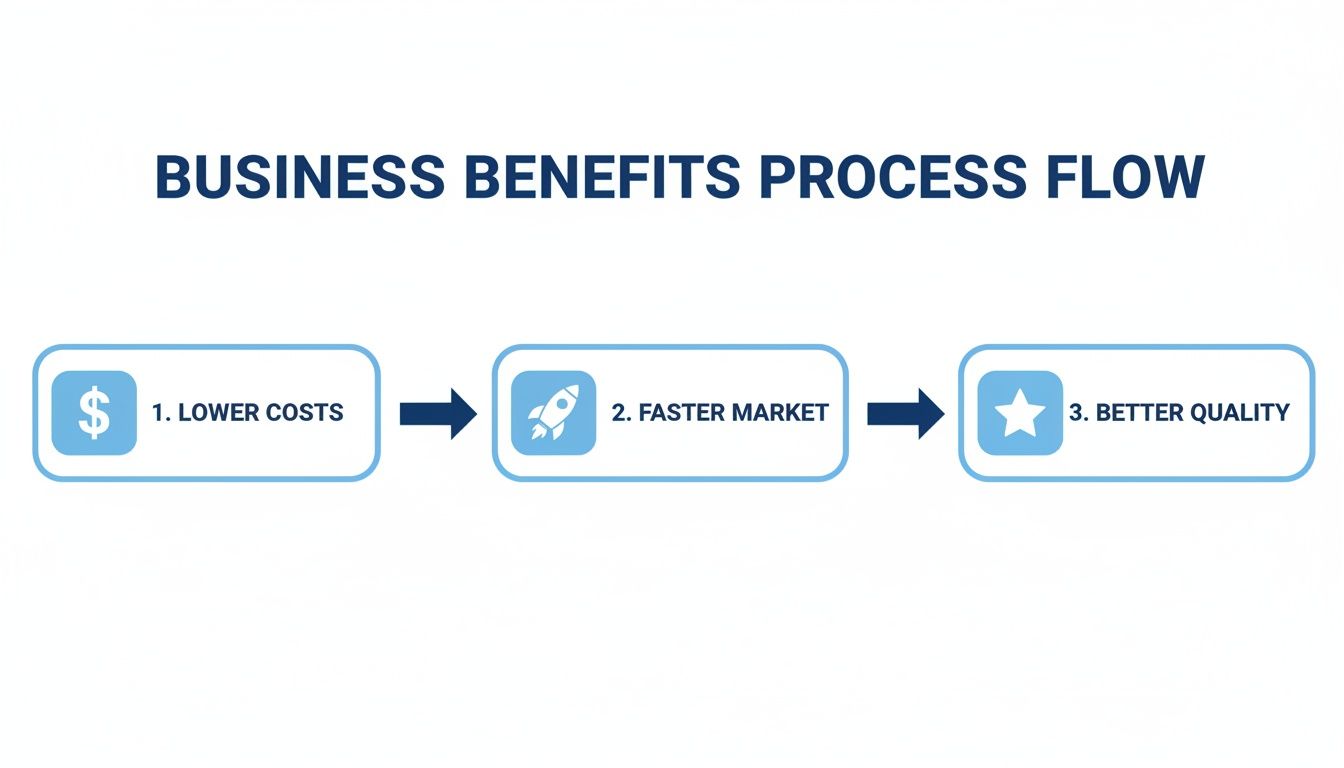
As you can see, the connection is clear. Catching problems early directly translates to lower development costs, faster delivery times, and a product that just works better.
Build a Smart Test Automation Strategy
To pull this off, you need a smart automation strategy. Don't fall into the trap of trying to automate everything at once. A much better approach is to follow the test pyramid model. It’s a simple but powerful framework for figuring out where to focus your automation efforts for the biggest bang for your buck.
- Unit Tests (The Foundation): This is the base of your pyramid and should be its biggest part. These are fast, isolated tests written by developers to check if individual chunks of code do what they’re supposed to. They’re cheap to write and incredibly fast to run.
- Integration Tests (The Middle Layer): Next up, you have tests that check how different parts of your application work together. Do your microservices talk to each other correctly? Does the API connect to the database properly? These are a bit slower but are absolutely essential for finding those tricky bugs that hide at the seams.
- End-to-End Tests (The Peak): At the very top, you have a small number of end-to-end (E2E) tests. These simulate a complete user journey, like signing up and making a purchase. They are slow, expensive, and notoriously brittle, so use them sparingly only for your most critical workflows.
This pyramid structure helps you build a test suite that's robust, fast, and easy to maintain. If you want to dive deeper into building a solid testing framework, check out our guide on software testing best practices.
Foster a Culture of Quality Ownership
Tools and processes are important, but the real secret to shifting left successfully is a cultural change. If your developers see this as just "more work," it's doomed to fail. You have to create a collaborative environment where quality is everyone's job, not just QA's problem.
The core idea here is empowerment. Give your developers the tools, the training, and the freedom to own the quality of their code. When they can run static analysis, security scans, and unit tests right from their IDE, testing stops feeling like a roadblock and becomes part of the creative flow.
To make this cultural shift stick, you have to tear down the walls between development and QA. Get developers and testers working together—pairing on writing tests is a great way to start. This cross-pollination of skills gets developers thinking more like testers and gives testers a much deeper insight into the code. This collaboration is what really powers a successful shift-left strategy, turning it from a process on a whiteboard into a daily reality.
Using AI in the IDE to Supercharge Your Shift Left Strategy
The purest form of shifting left is catching a mistake the instant a developer types it. This isn't science fiction anymore. Modern AI coding assistants make this a daily reality by pushing quality checks to the furthest point left imaginable—right inside the developer's IDE.
This is a massive leap forward. Instead of waiting for a CI pipeline to fail, developers get immediate, real-time feedback on bugs, security flaws, and compliance issues while they’re still in the zone. It’s like having an expert reviewer looking over your shoulder, offering corrections as you go.
This proactive approach stops bad code from ever being committed, let alone making it to the CI/CD pipeline. The impact is huge. You slash rework and save countless engineering hours that would otherwise be burned on debugging.
AI as Your Automated Code Reviewer
Think of these in-IDE tools as automated code reviewers that work at lightning speed. They go way beyond simple syntax errors; they understand the code's context, analyze its logic, and check it against established best practices and security rules. This immediate feedback loop is the core idea of shift-left testing, executed perfectly.
Here’s what this looks like in practice—an AI providing instant feedback on code quality and security right inside the editor.

The screenshot shows a developer getting insights without ever leaving their editor. No more context switching. They just stay in a state of flow and build.
This changes the entire game by:
- Preventing Bad Commits: By flagging problems early, it ensures only high-quality, secure code ever makes its way into the repository.
- Enforcing Consistency: It automatically applies team-wide coding standards, naming conventions, and security policies, creating consistency without manual nagging.
- Reducing PR Ping-Pong: It kills the tedious back-and-forth during pull request reviews because most issues are fixed before the PR even exists.
The real power here is scale. An AI platform can automatically enforce best practices and security guardrails across an entire engineering org, making a robust shift-left strategy not just possible, but seamless.
Making a Scalable Shift Left Strategy a Reality
Getting a shift-left culture to stick is tough, especially on large teams where standards can easily drift. AI-powered tools solve this by making quality operational. They become the central enforcement point, making sure every developer, from junior to senior, is held to the same high standard.
This automation creates a positive feedback loop. Developers learn best practices naturally through instant feedback, code quality improves everywhere, and security becomes a built-in part of the process, not a late-stage scramble. To see just how much this is changing things, you can learn more about the rise of AI-powered IDEs and what they mean for developer productivity.
Ultimately, integrating AI directly into the developer's workflow is the most effective way to do shift-left right. It transforms quality assurance from a separate, delayed stage into something that happens in real time, empowering developers to ship better, more secure code faster than ever.
Measuring the Success of Your Shift Left Initiative
So, how do you actually know if your big push to shift left is paying off? You can't just go by gut feeling. Shifting left is a real investment in time and resources, and you need hard data to show it’s working. Proving the ROI comes down to tracking the right numbers.
To get a clear picture, you have to focus on the key performance indicators (KPIs) that tell the true story. These aren't just vanity metrics; they reveal the real-world impact on your team's speed and the stability of your product.
Key Metrics That Tell the Story
Start by tracking a handful of critical metrics that directly reflect the health of your development lifecycle. These KPIs will give you concrete proof of your progress and show you where you might need to tweak your approach.
Here are the essentials to keep an eye on:
- Defect Escape Rate: This is arguably the most important one. It measures the percentage of bugs that slip through the cracks and are only found in production. If you're shifting left successfully, this number should drop like a rock because you're catching issues way earlier.
- Mean Time to Resolution (MTTR): How long does it take your team to squash a bug once it's found? Shifting left should slash your MTTR. It’s a lot faster for a developer to fix a bug in code they just wrote, not something they have to dig up from weeks ago.
- Build Failure Rate: This tracks how often your CI/CD pipeline breaks because of failed tests. A rising build failure rate might sound bad, but it can actually be a great sign. It means your automated tests are doing their job and catching bugs before they ever get a chance to move down the line.
The whole point is to create a data-driven feedback loop. By keeping a close eye on these numbers, you can spot trends, celebrate the wins, and make smart decisions to fine-tune your process for the biggest impact.
Tying Metrics to Business Outcomes
At the end of the day, these numbers are powerful because they connect directly to business value. A lower defect escape rate means happier customers and less pressure on your support team. A shorter MTTR frees up your engineers to build cool new features instead of constantly putting out fires.
This isn't just a niche idea, either. The entire industry is moving this way. By 2025, it's estimated that 70% of enterprises will be using AI-driven tools to get their quality processes in order, with shift-left strategies being a huge part of that push. You can discover more insights about AI's role in quality engineering to see just how big this trend is.
By tracking the right KPIs now, you're not just improving your workflow—you're getting ahead of the curve.
Common Shift Left Pitfalls and How to Avoid Them
Moving to a shift left model is a game-changer, but it's not a flip of a switch. Plenty of teams get excited about the idea, dive in, and then hit a wall. Knowing where others have stumbled is the best way to make sure you don't repeat their mistakes.
The biggest mistake? Throwing money at tools and expecting the culture to magically follow. Buying the fanciest test automation suite on the market does absolutely nothing if your developers and QA engineers still operate in separate silos. Shift left is a mindset, a commitment to shared ownership of quality, not just a new piece of software.
Overlooking Essential Training
Another classic blunder is asking developers to write more tests without actually teaching them how to write good ones. It's a fast track to frustration and burnout. You can't just mandate quality; you have to enable it by giving your team the skills they need to succeed.
To get this right, you need to invest in your people:
- Run Workshops: Get hands-on with sessions covering unit testing frameworks, how to use static analysis tools, and secure coding practices.
- Pair Up: Get developers and QA engineers working side-by-side to write tests. It's one of the fastest ways to cross-pollinate skills and build mutual understanding.
- Write It Down: Create clear, accessible documentation on your quality standards. When everyone knows what "good" looks like, it's a lot easier to achieve.
When you do this, testing stops being a chore and becomes a core part of the engineering craft.
The real trap is treating shift left like a project with a start and end date. It's not a destination you arrive at. It’s a continuous process of improvement, a cultural shift where quality becomes everyone’s job, all the time.
Setting Unrealistic Automation Goals
Finally, teams often get obsessed with hitting 100% test coverage. This sounds great on a slide deck, but in reality, it often leads to a mess of brittle, low-value tests that break with every minor change and become a maintenance nightmare.
The smarter approach is to be strategic. Don't try to automate everything at once. Focus your efforts on the highest-risk parts of your application—the critical paths that absolutely cannot fail. Use the test pyramid as your guide, building a massive base of fast, reliable unit tests. By sidestepping these common traps, you set your team up for a shift left transition that's not just successful, but sustainable.
Got Questions About Shift-Left?
Even when the concept makes sense on paper, moving to a shift-left model brings up a lot of practical questions. Let's tackle some of the most common ones we hear from teams who are thinking about making the switch.
Does Shift-Left Mean Our Developers Have to Do All the Testing Now?
Not a chance. This is probably the biggest myth out there about what shift-left testing really is. It’s not about firing your QA team or just dumping all the testing work onto developers.
What it really means is making quality a shared responsibility. Developers step up and own the initial quality checks—things like writing solid unit tests and running static analysis on their own code. This frees up your QA specialists from the grind of finding the same simple bugs over and over again late in the game.
Instead of just hunting for bugs, the QA role transforms. Testers become quality coaches, architects for the test automation strategy, and masters of exploratory testing. They help developers build testability into the code right from the start.
How Is This Different From DevSecOps?
It's easy to see why people mix these two up. They're definitely related and work great together, but they're not the same thing.
Here’s a simple way to think about it:
- Shift-Left is the big-picture philosophy. It’s about moving all types of quality checks—performance, security, usability, you name it—as early as possible in the development process.
- DevSecOps is one specific, crucial application of that philosophy. It focuses entirely on embedding security checks and practices into the DevOps pipeline from day one.
So, you could say DevSecOps is just "shifting security left." Every DevSecOps practice is a form of shifting left, but not everything you shift left is about security.
Can We Actually Do This With Our Old Legacy System?
Yes, you absolutely can, but you have to be smart about it. You can't just flip a switch and expect a decade-old monolith to suddenly work like a modern microservice. The trick is to start small and be realistic.
A great place to begin is with any new code you're adding to the legacy system. When you build a new feature or module, treat it like a greenfield project. Insist on unit tests for that new code and get it running through automated checks in your CI/CD pipeline.
Over time, you can slowly chip away at the old code, maybe focusing on the parts that are highest-risk or change most often. You might never get 100% test coverage like you would on a new app, but every single step you take to the left makes that old system less risky and easier to maintain.
Ready to see what a real shift-left strategy can do? With kluster.ai, you can find and fix bugs and security flaws the moment they're written, right inside your IDE. Our AI-powered code review platform helps your team enforce quality standards automatically and ship code you can trust, way faster.
Start your free trial today and watch how instant feedback changes everything.