

10 Code Review Good Practices to Ship Flawless Code in 2026
In fast-paced development cycles, traditional pull request reviews are becoming a bottleneck. They can be slow, inconsistent, and often miss critical issues, especially in AI-generated code. A modern approach to code review isn't just about finding bugs; it’s a strategic advantage that ensures quality, security, and velocity. Shifting reviews left into the integrated development environment (IDE), automating policy enforcement, and applying enhanced scrutiny to AI-generated code are no longer optional. They are essential for shipping reliable software efficiently.
This article rounds up 10 actionable code review good practices that engineering teams can implement today. Our goal is to help you eliminate PR ping-pong, catch errors before they're even committed, and merge trusted, production-ready code in minutes, not days. We will cover a comprehensive range of topics tailored for today's development challenges, including:
- Establishing clear standards and guidelines for consistency.
- Implementing continuous, real-time code review directly in the IDE.
- Enforcing security and compliance policies automatically to prevent vulnerabilities.
- Providing constructive, actionable feedback to foster a learning-oriented culture.
We'll explore everything from defining a solid review foundation to leveraging real-time, AI-assisted tools that transform reviews from a dreaded chore into a seamless, value-adding part of the development workflow. Whether you're an engineering manager aiming to enforce standards, a security team looking to prevent vulnerabilities, or a developer wanting to accelerate release cycles, these practices provide a clear roadmap to building a more effective and scalable review process.
1. Establish Clear Code Review Standards and Guidelines
The foundation of any effective code review process is a set of explicit, documented standards that every team member can access and follow. Instead of relying on unwritten rules or individual preferences, establishing clear guidelines transforms code reviews from subjective debates into objective evaluations. This approach is a cornerstone of code review good practices because it creates a shared understanding of what "good code" looks like for your team, minimizing friction and improving consistency across the codebase. These standards should cover everything from stylistic choices to critical security requirements.
Why Clear Standards Matter
Without a documented baseline, reviewers may offer conflicting feedback based on personal habits, leading to confusion and unproductive discussions. A developer might receive notes to use camelCase from one reviewer and snake_case from another on the same pull request. Clear standards eliminate this ambiguity, allowing reviews to focus on more significant issues like logic, architecture, and performance rather than trivial style debates.
Many successful organizations publish their standards. For instance, Airbnb's JavaScript Style Guide is a well-regarded public resource that provides a comprehensive rule set. Similarly, Google maintains extensive internal style guides for numerous languages, which serve as the definitive source of truth for its engineering teams.
How to Implement and Maintain Standards
Creating and maintaining effective guidelines is a collaborative, ongoing process.
- Start Small and Iterate: Begin with a core set of rules covering critical areas like naming conventions, error handling, and security basics. Don't try to codify everything at once.
- Centralize and Organize: Host your guidelines in a central, searchable location like a team wiki or a dedicated repository in your version control system.
- Automate Enforcement: Use linters, static analysis tools, and modern AI-powered platforms to automatically check for compliance. For example, enterprise teams can use tools to auto-enforce specific naming conventions or security policies directly within the developer's IDE, preventing non-compliant code from ever being committed.
- Review and Refine: Revisit your standards annually. Solicit feedback from the entire team to ensure the guidelines evolve with your projects, technologies, and team members.
2. Review AI-Generated Code with Enhanced Scrutiny
The rise of AI coding assistants has revolutionized development speed, but it also introduces unique challenges that demand a specialized review process. Applying heightened scrutiny to AI-generated code is a critical modern practice because these tools can produce output with subtle flaws, including logical errors, security vulnerabilities, or performance bottlenecks that a human developer might not introduce. A dedicated verification process ensures that the convenience of AI doesn't come at the cost of code quality, security, or correctness.

Why Enhanced Scrutiny Matters
Unlike human-written code, AI-generated code can suffer from "hallucinations," where the model confidently produces code that is nonsensical or fails to meet the prompt's requirements. It may also introduce outdated dependencies or insecure patterns learned from its vast training data. To better understand the nuances of AI detection, especially when reviewing code, it's insightful to know what AI detectors look for in terms of patterns and artifacts. This knowledge helps reviewers adopt the right mindset for verification.
For instance, a developer using GitHub Copilot might accept a function that appears correct but contains a subtle regular expression denial-of-service (ReDoS) vulnerability. Without a review process tailored for common issues in AI-generated code, such flaws can easily slip into production. Enhanced scrutiny moves the review focus from simple syntax to deep validation of logic and security.
How to Implement and Maintain AI Code Review Standards
Adopting a structured approach to reviewing AI-assisted code is essential for mitigating its risks.
- Verify Against Original Intent: Always validate that the AI's output precisely matches the original prompt or requirement. Check for subtle deviations in logic that could lead to unexpected behavior.
- Establish AI-Specific Checklists: Create review templates that prompt reviewers to check for common AI pitfalls, such as improper error handling, security vulnerabilities, and performance inefficiencies.
- Test Edge Cases Rigorously: AI-generated code often handles the "happy path" well but may neglect edge cases. Your testing process should explicitly cover these scenarios.
- Leverage AI for Verification: Use modern, in-IDE tools to provide instant feedback and verification of AI-generated code. For example, platforms like kluster.ai can detect and fix hallucinations or policy violations in seconds, preventing flawed code from ever reaching a pull request. This proactive approach is far more efficient than post-commit reviews.
3. Implement Continuous Code Review in the IDE
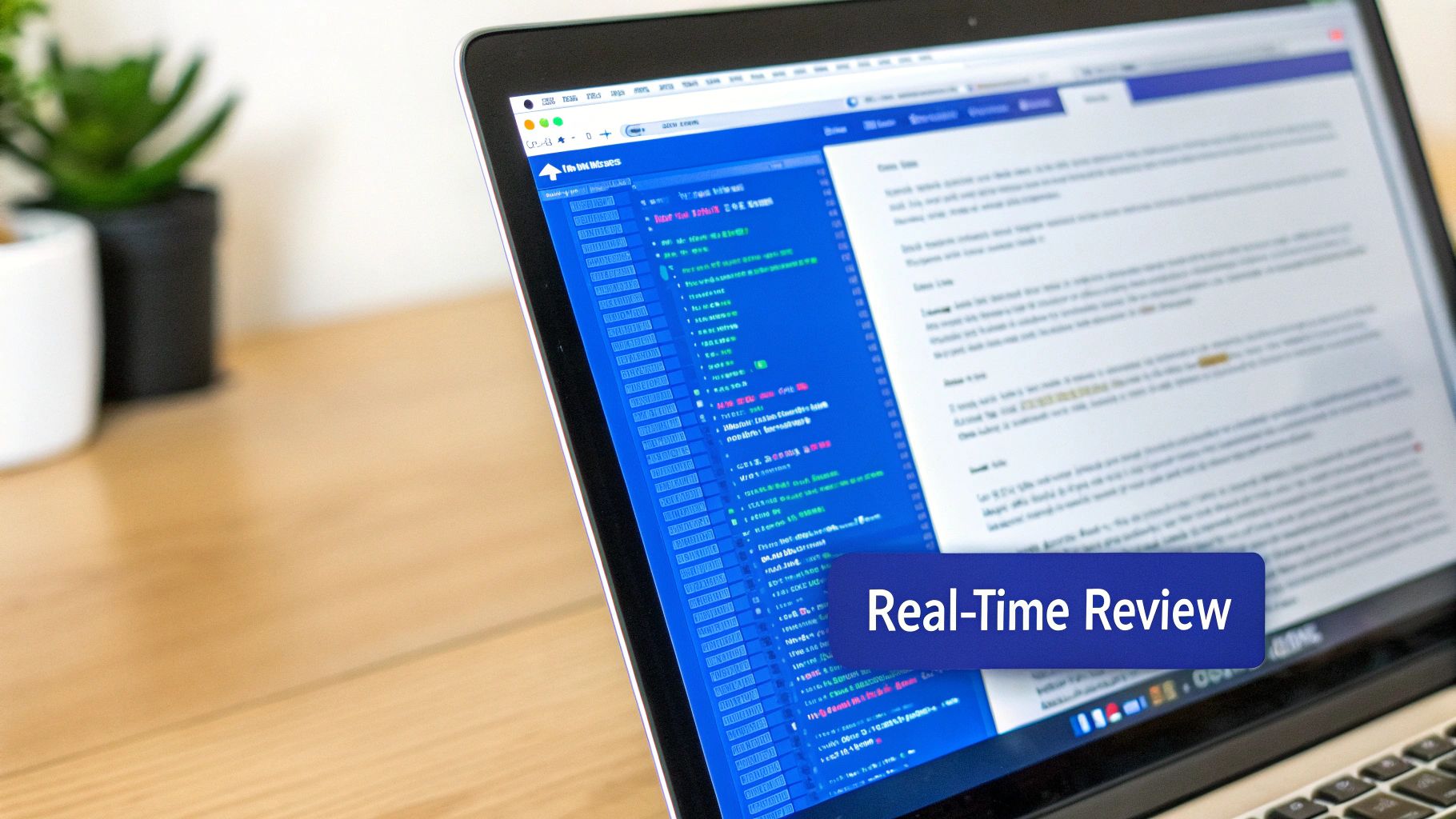
The traditional code review process, which happens after code is committed and a pull request is created, often introduces significant delays. A more modern approach involves shifting this feedback loop directly into the developer's Integrated Development Environment (IDE). Implementing continuous code review provides real-time, context-aware suggestions as code is being written. This shift-left strategy is one of the most impactful code review good practices because it catches issues at their source, preventing flawed code from ever entering the version control system and enabling corrections while the context is fresh in the developer's mind.
Why In-IDE Review Matters
Waiting until the pull request stage to identify simple errors, style violations, or potential bugs is inefficient. It creates a costly cycle of feedback, context-switching, and rework. In-IDE review tools eliminate this latency by providing instant analysis, turning the review process into a proactive, educational experience rather than a reactive, corrective one. This immediate feedback helps developers learn and internalize standards faster.
Modern AI-powered tools like kluster.ai exemplify this approach, delivering feedback in as little as five seconds directly within editors like VS Code and Cursor. Similarly, SonarQube's IDE plugins bring continuous quality checks to the developer's fingertips. Fast-growing product teams have reported halving their review time by adopting this in-IDE verification model, accelerating their development velocity without sacrificing quality.
How to Implement and Maintain In-IDE Review
Integrating continuous review into your team's workflow requires thoughtful configuration and a focus on the developer experience.
- Integrate Seamlessly: Choose tools that integrate directly with your team's preferred IDEs, ensuring a frictionless workflow without requiring developers to switch contexts.
- Prioritize Low Latency: For feedback to be effective, it must be nearly instant. Aim for tools that provide analysis in under 10 seconds to avoid disrupting the creative flow.
- Configure Thoughtfully: Start by configuring tools to offer non-blocking suggestions. Use severity levels (e.g., critical, major, minor) to help developers prioritize the most important issues.
- Tune and Track: Adjust notification frequency to prevent developer fatigue and track key metrics like review time reduction and pre-commit issue detection rates to measure the impact of your implementation.
4. Enforce Security and Compliance Policies Automatically
Relying solely on human reviewers to catch security flaws is a high-risk strategy. A robust code review process integrates automated tools to detect and prevent security vulnerabilities, compliance violations, and policy breaches before problematic code is ever merged. This DevSecOps approach is a critical component of modern code review good practices, as it shifts security left, making it a proactive part of the development lifecycle rather than a reactive, last-minute check. This ensures common vulnerabilities like SQL injection, cross-site scripting (XSS), and hardcoded credentials are flagged and fixed early.
Why Automated Enforcement Matters
Manual security reviews are prone to human error and inconsistency, especially when dealing with complex compliance standards like SOC 2, HIPAA, or PCI-DSS. Automated enforcement provides a reliable, repeatable safety net that operates continuously. It allows security teams to define and scale guardrails across the entire organization, ensuring that all code adheres to the same high standard without slowing down development cycles. This frees up human reviewers to focus on complex logic and architectural soundness, knowing that a baseline of security and compliance is already met.
Tools like GitHub Advanced Security scan for known vulnerabilities, while GitLab offers built-in SAST and Dependency Scanning. More advanced AI-powered platforms like Kluster can enforce granular, organization-wide security policies and compliance rules directly within the developer's IDE, preventing violations from being written in the first place.
How to Implement and Maintain Automated Enforcement
Integrating security automation is a strategic process that requires clear policies and continuous refinement.
- Start with High-Impact Rules: Begin by automating checks for high-severity, high-frequency vulnerabilities, such as hardcoded secrets or outdated dependencies. This delivers immediate security value.
- Tune Rules to Your Risk Profile: Customize scanning rules to align with your organization's specific risk tolerance and compliance needs. Avoid overly generic policies that create excessive noise.
- Make Policies Actionable: Ensure that when a tool flags an issue, it provides clear, actionable feedback on why it's a problem and how to fix it. This empowers developers to learn and self-remediate.
- Establish Exception Workflows: Create a formal process for developers to request exceptions to a policy when necessary, complete with an approval and audit trail.
- Educate and Empower Teams: Regularly educate developers on the "why" behind each security rule. When developers understand the risks a policy prevents, they become active participants in building a secure codebase.
5. Perform Thorough Testing Before Code Review
Submitting code for review without adequate testing is like asking a proofreader to check a first draft full of basic typos. A core tenet of effective code review good practices is to ensure that code is functionally correct and robust before it reaches a human reviewer. By catching bugs, edge case failures, and regressions through a comprehensive test suite, developers save reviewers’ time and cognitive energy, allowing them to focus on higher-level concerns like architecture, readability, and logic. This self-service validation is even more critical when working with AI-generated code, which must be rigorously verified for correctness.
Why Pre-Review Testing Matters
When a reviewer has to identify functional bugs that a test could have caught, the review process becomes inefficient and frustrating. It shifts the burden of quality assurance from automated processes to manual inspection, slowing down the entire development lifecycle. Requiring passing tests as a prerequisite for review ensures a baseline level of quality and correctness, making the human review far more productive and valuable.
Leading tech organizations institutionalize this practice. For example, Google famously requires comprehensive unit tests to accompany all new code, a policy that underpins its culture of engineering excellence. Similarly, modern CI/CD pipelines, common on platforms like GitHub and GitLab, are configured to automatically run tests on every commit and block merges if they fail, formally integrating testing as a non-negotiable step before review.
How to Implement and Maintain Pre-Review Testing
Integrating robust testing into your pre-review workflow is a cultural and technical shift that pays significant dividends.
- Define Coverage Thresholds: Establish a minimum code coverage standard (e.g., 80%+) to ensure new logic is adequately tested. While not a perfect metric, it provides a tangible baseline.
- Integrate CI Checks: Configure your CI/CD pipeline to automatically run your full test suite on every pull request. Make passing checks a mandatory requirement before a review can even be requested.
- Test More Than the "Happy Path": Write tests that cover error conditions, invalid inputs, security vulnerabilities (like SQL injection), and performance edge cases, not just expected behavior.
- Validate AI-Generated Code: When using AI coding assistants, create tests based on the original requirements first. Use these tests to validate that the generated code functions correctly and meets all specifications. Platforms like kluster.ai accelerate this by providing immediate, in-IDE testing feedback for AI suggestions, confirming their validity on the spot.
6. Maintain Small, Focused Pull Requests
One of the most impactful code review good practices is to keep pull requests (PRs) small and focused on a single, atomic change. Instead of bundling multiple features, bug fixes, and refactors into one monolithic PR, breaking work down into digestible units transforms the review process. This approach makes changes easier for reviewers to understand, faster to approve, and significantly safer to merge. Small PRs reduce cognitive load, enabling a more thorough and effective review.
Why Small Pull Requests Matter
Large, complex PRs are a common source of friction. They are intimidating to review, leading to reviewer procrastination and superficial feedback. A reviewer faced with thousands of lines of changes is more likely to miss subtle bugs, security flaws, or architectural inconsistencies. By keeping PRs small, you encourage prompt, high-quality feedback and accelerate the development cycle.
This principle is a cornerstone of effective engineering cultures. Google famously encourages small, focused changelists (CLs), their equivalent of PRs, to maintain a high velocity of safe, continuous integration. Similarly, the Kubernetes open-source project enforces policies requiring small, scoped PRs to manage contributions from thousands of developers effectively. This is also critical when working with AI-generated code, as smaller chunks are far easier to verify for correctness and security.
How to Implement and Maintain Small PRs
Adopting a small-PR methodology requires discipline and a shift in workflow.
- Decompose Large Features: Break down epic-level tasks into smaller, logical sub-tasks that can each be implemented and merged independently. Use feature flags to hide incomplete functionality from users.
- Separate Concerns: Never mix refactoring with feature work in the same PR. A PR should either introduce new behavior or improve existing code, but not both.
- Write Clear, Contextual Descriptions: A great PR description explains the "why" behind the change, not just the "what." Link to the relevant issue or ticket to provide full context for the reviewer.
- Aim for a Single-Sitting Review: A good rule of thumb is that a reviewer should be able to comprehend and complete the review in one sitting, typically under 20-30 minutes. If it’s longer, the PR is likely too large.
7. Use Automated Tools and Linters Consistently
Manual code reviews should focus on complex logic, architectural soundness, and problem-solving, not on debating semicolons or import order. One of the most impactful code review good practices is offloading mechanical checks to automated tools. By leveraging linters, formatters, and static analysis, teams can consistently enforce standards, catch common bugs, and identify security vulnerabilities before a human reviewer even sees the code. This frees up valuable cognitive resources for higher-level evaluation, making the entire process faster and more effective.
Why Automation Matters
Automated tools act as an impartial first line of defense. They eliminate subjective style arguments by enforcing a single, agreed-upon standard, which significantly reduces review friction. A developer using ESLint with Prettier for a JavaScript project, for instance, won't have their pull request blocked by comments about inconsistent brace placement. The tool handles it automatically.
Furthermore, platforms like SonarQube and GitHub's dependency scanning can detect critical issues like potential null pointer exceptions, security flaws, and outdated libraries. This layer of automation ensures a baseline level of quality and security is met on every commit, reducing the burden on human reviewers to spot every single flaw. Integrating these checks into the development lifecycle is a key component of modern, efficient workflows.
How to Implement and Maintain Automation
Integrating automated tooling requires a thoughtful, team-wide approach to be successful.
- Centralize Configuration: Store tool configuration files (e.g.,
.eslintrc.json,.prettierrc) in the project's root directory. This ensures every developer uses the exact same rules, whether in their IDE or in the CI/CD pipeline. - Integrate Everywhere: Run these tools in multiple places for maximum impact. Configure them in developer IDEs for real-time feedback, use pre-commit hooks to catch issues before code is pushed, and run them as a required check in your CI pipeline.
- Start Small and Tune: Begin with a standard, widely accepted ruleset and customize it over time. Regularly review the rules to reduce false positives and ensure they provide genuine value without creating unnecessary noise.
- Educate the Team: Ensure everyone understands why the tools are in place and how to interpret their output. This turns automation from a gatekeeper into a helpful assistant. For more insights on this topic, explore this comprehensive guide to code review automation tools.
8. Provide Constructive, Actionable Feedback
The quality of feedback can make or break a code review process. Constructive, actionable comments transform reviews from critiques into collaborative learning opportunities. Instead of just pointing out what’s wrong, effective feedback explains why a change is needed and suggests specific ways to improve it. This approach is a critical code review good practice because it accelerates problem-solving, prevents defensiveness, and fosters a culture of mutual respect and continuous improvement. The goal is to critique the code, not the coder.

Why Constructive Feedback Matters
Vague feedback like "this is confusing" or "needs refactoring" leaves developers guessing, which slows down the development cycle. In contrast, actionable feedback provides a clear path forward. This approach is exemplified by the React.js core team, whose public pull request discussions are often educational, explaining the reasoning behind requested changes with empathy and clarity. Similarly, many successful open-source projects thrive because their maintainers prioritize mentoring contributors through thoughtful feedback.
Modern AI tools are also designed to embody this principle. For instance, Kluster's in-IDE AI review assistant provides suggestions that are not only specific but also include code examples and links to documentation, directly teaching best practices at the moment they are most relevant.
How to Give Better Feedback
Adopting a constructive mindset requires conscious effort and a consistent framework.
- Explain the 'Why': Always connect your feedback to a principle, standard, or potential impact. For example, instead of "rename this variable," try "Let's rename this variable to
userProfileto better align with our naming conventions and improve readability." - Suggest Alternatives: Offer specific code snippets or alternative approaches. This shows you've thought through the problem and provides a concrete starting point for the author.
- Ask, Don't Tell: When you're unsure of the author's intent, ask clarifying questions. A comment like "Could you walk me through the reasoning here? I'm wondering if a different approach might simplify the logic" opens a dialogue rather than making a demand.
- Balance Critique with Praise: Acknowledge well-written code, clever solutions, or thorough test cases. Positive reinforcement is a powerful tool for morale and helps ensure the author remains receptive to constructive criticism.
9. Foster a Learning-Oriented Review Culture
Effective code reviews are more than just a gatekeeping mechanism to catch bugs; they are a powerful engine for team growth and knowledge sharing. A learning-oriented review culture shifts the focus from merely approving or rejecting code to actively mentoring and elevating the entire team's skills. This approach is one of the most impactful code review good practices because it creates a positive feedback loop where every pull request becomes an opportunity to share context, discuss architectural decisions, and build collective ownership of the codebase.
Why a Learning Culture Matters
When reviews are treated as teaching moments, they break down knowledge silos and reduce the "bus factor" by distributing expertise across the team. Instead of a senior developer simply stating "Fix this," they might ask, "Have you considered how this approach might affect database performance under high load?" This prompts critical thinking and builds a deeper understanding of the system's architecture.
This philosophy is central to many high-performing engineering organizations. Basecamp famously views its code review process as a primary mentoring channel, while open-source communities like Rust and Kubernetes thrive by fostering a welcoming environment where experienced contributors guide newcomers through constructive feedback.
How to Foster a Learning-Oriented Culture
Building a culture of continuous learning requires intentional effort and specific practices.
- Frame Feedback as Questions: Encourage reviewers to ask questions like, "What was the reasoning behind this choice?" or "Could you walk me through the logic here?" This invites dialogue rather than commanding changes.
- Pair Developers Strategically: Assign junior developers' pull requests to senior reviewers who can provide detailed, context-rich feedback. This accelerates onboarding and skill development.
- Document and Share Patterns: When a review uncovers a clever solution or a common anti-pattern, document it in a team wiki. This creates a shared library of best practices. To truly foster a learning-oriented culture, consider implementing practices like an After Action Review to analyze review outcomes and identify areas for growth and improvement.
- Recognize Good Questions: Publicly acknowledge and praise insightful questions from both the author and the reviewer. This reinforces that curiosity and learning are valued team traits.
10. Monitor, Measure, and Continuously Improve Review Process
A static code review process will eventually become a bottleneck. To maintain efficiency and quality, teams must adopt a data-driven approach, transforming their review cycle from a fixed routine into an evolving, optimized system. This is a critical code review good practice because it replaces guesswork with objective insights, allowing you to pinpoint and resolve friction points before they derail your development velocity. By tracking key metrics, you can ensure your process remains effective as your team, codebase, and tools change.
Why Measurement Matters
Without data, improvements are based on anecdotes and assumptions. You might think reviews are slow, but metrics can reveal the bottleneck is actually the time PRs wait before the first review. Measuring the process provides a clear picture of its health, enabling targeted enhancements. It helps answer crucial questions: Are reviews becoming a bottleneck? Is code quality improving or declining? Are our new tools making a tangible impact?
For example, many teams use GitHub's built-in analytics to track metrics like "Time to Open" and "Time to Merge," providing a high-level view of review velocity. Similarly, engineering intelligence platforms offer deep dives into metrics like "Review Cycles" and "Defect Escape Rate," which measures the number of bugs that make it to production, to quantify quality.
How to Implement and Maintain Measurement
Implementing a metrics-driven improvement cycle requires a focused, team-oriented approach.
- Focus on Process, Not People: The goal is to optimize the system, not to evaluate individual developers. Frame metrics around team and process health, such as average review turnaround time, not individual reviewer speed. This fosters a culture of collective ownership.
- Track Both Speed and Quality: Balance velocity metrics (e.g., review time) with quality indicators (e.g., defect escape rate, comments per review). Optimizing for speed alone can compromise code quality.
- Establish a Baseline: Before introducing a new tool or process change, measure your current state. This baseline is essential for proving the change's effectiveness. For instance, teams adopting new AI review tools have reported a 50% reduction in review time after establishing and comparing against their initial baseline.
- Review and Act Regularly: Dedicate time in team meetings to review the metrics monthly. Discuss trends, investigate outliers, and brainstorm actionable improvements together. This transparency builds trust and encourages continuous improvement.
10-Point Code Review Comparison
| Practice | Implementation Complexity 🔄 | Resource Requirements ⚡ | Expected Outcomes ⭐ / 📊 | Ideal Use Cases 💡 | Key Advantages ⭐ |
|---|---|---|---|---|---|
| Establish Clear Code Review Standards and Guidelines | Medium 🔄🔄 | Medium — documentation + linters | Consistent code quality ⭐⭐; faster, objective reviews 📊 | Scaling teams, onboarding, multi-language projects 💡 | Clear criteria, automation-friendly, easier onboarding ⭐ |
| Review AI-Generated Code with Enhanced Scrutiny | High 🔄🔄🔄 | High — AI expertise, specialized scanners, trained reviewers | Fewer hallucinations/logic/security bugs ⭐⭐⭐; reduced production incidents 📊 | Teams using AI assistants heavily; safety-critical code 💡 | Detects AI-specific failures (hallucinations/vulns) ⭐ |
| Implement Continuous Code Review in the IDE | Medium-High 🔄🔄🔄 | Medium — IDE integration, tuning, plugin maintenance | Immediate feedback ⚡⚡; shorter review cycles and fewer PR queues 📊 | Fast-moving teams, AI-assisted workflows, high-velocity dev 💡 | Preserves developer flow, faster merges, higher coverage ⭐ |
| Enforce Security and Compliance Policies Automatically | High 🔄🔄🔄 | High — security tooling, policy configs, ongoing tuning | Fewer vulnerabilities and compliance violations ⭐⭐⭐; audit trails 📊 | Regulated industries, large orgs, DevSecOps initiatives 💡 | Prevents breaches, scalable governance, automated audits ⭐ |
| Perform Thorough Testing Before Code Review | Medium 🔄🔄 | Medium — test suites, CI resources, test maintenance | Fewer defects at review time ⭐⭐; higher confidence and fewer hotfixes 📊 | Critical features, AI-generated code validation, TDD teams 💡 | Catches issues pre-review, documents behavior, reduces rework ⭐ |
| Maintain Small, Focused Pull Requests | Low 🔄 | Low — process discipline | Faster reviews ⚡; lower merge risk and simpler reverts 📊 | Trunk-based development, frequent releases, codebase hygiene 💡 | Easier to review/test/revert, quicker merges ⭐ |
| Use Automated Tools and Linters Consistently | Medium 🔄🔄 | Medium — initial setup, CI/IDE integration | Fewer style/low-level bugs ⭐; consistent codebase and objective metrics 📊 | Any codebase to reduce trivial review comments 💡 | Automates mechanical checks, scalable quality enforcement ⭐ |
| Provide Constructive, Actionable Feedback | Low-Medium 🔄🔄 | Low — reviewer time and communication effort | Faster resolution and learning-driven improvements ⭐📊 | Mentorship-focused teams, distributed/async reviews 💡 | Builds knowledge, reduces back-and-forth, improves morale ⭐ |
| Foster a Learning-Oriented Review Culture | Medium 🔄🔄 | Medium — leadership time, documentation, retros | Long-term skill growth and fewer repeated mistakes 📊 | Growing teams, strong onboarding, retention-focused orgs 💡 | Institutional knowledge, mentorship, better retention ⭐ |
| Monitor, Measure, and Continuously Improve Review Process | Medium-High 🔄🔄🔄 | Medium-High — metrics infra, dashboards, analysis | Data-driven optimizations; visible ROI of reviews 📊 | Organizations scaling reviews, measuring AI adoption/effectiveness 💡 | Identifies bottlenecks, tracks impact, supports decisions ⭐ |
Build Your High-Velocity, High-Quality Review Workflow
Navigating the landscape of modern software development requires more than just writing functional code; it demands a robust, efficient, and collaborative process for ensuring quality and security. The comprehensive list of code review good practices we have explored moves your team beyond the traditional, often-dreaded review cycle. Instead of treating code review as a final, monolithic gate, this framework transforms it into a continuous, integrated system that empowers developers, strengthens security, and accelerates innovation.
The central theme connecting these practices is a strategic "shift left." By moving quality and security checks earlier into the development lifecycle, directly into the Integrated Development Environment (IDE), you fundamentally change the dynamic. Mechanical checks are automated, policies are enforced in real-time, and developers receive instant, contextual feedback when they are most receptive to it. This approach minimizes the friction and delay typically associated with pull requests, turning reviews from a bottleneck into a catalyst for improvement.
From Manual Checks to an Automated Quality Engine
The journey from good to great code review involves a deliberate transition from manual, subjective feedback to a streamlined, automated workflow. Adopting practices like maintaining small, focused pull requests and using automated linters lays the foundational groundwork. However, the real transformation occurs when you build upon this with a culture of constructive feedback and a commitment to continuous measurement and improvement.
Consider the compounding benefits:
- Small Pull Requests make reviews faster and more thorough.
- Automated Tools handle stylistic and simple logical errors, freeing up human reviewers to focus on complex logic and architecture.
- A Learning-Oriented Culture turns every comment into a teaching moment, elevating the entire team's skill set.
- Continuous In-IDE Review provides the ultimate "shift left," catching issues at the moment of creation, not hours or days later.
For teams leveraging AI-powered coding assistants, this proactive, in-IDE approach is no longer a luxury, it's a necessity. AI-generated code, while powerful, can introduce subtle bugs, security vulnerabilities, and logical "hallucinations." A modern review process must be equipped to validate this code against its original intent with enhanced scrutiny, ensuring that AI-driven productivity does not come at the cost of quality or security.
Your Actionable Roadmap to Better Reviews
Mastering these code review good practices is an iterative process, not an overnight overhaul. The key is to start small, build momentum, and demonstrate value quickly. Don't try to implement all ten practices at once. Instead, choose the one or two that address your team's most significant pain points.
Here’s a practical path forward:
- Assess Your Current State: Begin by measuring your existing process. What is your average pull request size? How long does a review typically take? Where are the most common bottlenecks?
- Pick Your First Initiative: If your PRs are too large, focus on #6: Maintain Small, Focused Pull Requests. If feedback is inconsistent, start with #8: Provide Constructive, Actionable Feedback and create a shared comment template.
- Integrate Automation: Introduce an automated linter or a continuous review tool that operates directly in the IDE. This single step can have a dramatic impact on catching errors early and enforcing standards without manual effort.
- Measure and Iterate: After implementing a new practice, revisit your metrics. Has the review cycle time decreased? Has the number of bugs caught post-deployment gone down? Use this data to justify further investment and guide your next steps.
By systematically adopting these practices, you create a flywheel effect where quality and velocity become mutually reinforcing. Faster, more effective reviews lead to faster merges, which in turn leads to a more agile and responsive development team. This is the ultimate goal: a high-velocity, high-quality workflow where code review is a strategic asset, not an operational burden.
Ready to automate your guardrails and slash review times? kluster.ai enforces your team's unique coding standards, security policies, and best practices directly in the IDE, providing real-time feedback on every line of code, including AI-generated suggestions. Stop waiting for pull requests and start building a high-velocity review culture by visiting kluster.ai to see it in action.