

Top 12 Regression Testing Automation Tools for Dev Teams in 2026
Regression testing is a critical, yet often time-consuming, part of the software development lifecycle. Without it, new features can inadvertently break existing functionality, leading to costly production bugs and eroding user trust. Manual regression testing simply cannot keep up with the pace of modern CI/CD pipelines. This is where regression testing automation tools come in; they provide the speed, coverage, and reliability needed to ship code with confidence.
However, the market is crowded with solutions ranging from open-source frameworks to enterprise-grade cloud platforms. Choosing the right tool is a significant decision that impacts developer productivity, release velocity, and overall product quality. Organizations seeking to enhance their development lifecycle often leverage expert software development consulting services to navigate these choices and integrate advanced testing strategies.
This guide cuts through the noise to help you make an informed decision. We provide an in-depth, practical analysis of the 12 best regression testing automation tools available today. For each tool, you will find:
- Key Features: A focused look at what makes each platform unique.
- Pros and Cons: An honest assessment of strengths and limitations.
- Best-Fit Use Cases: Clear guidance on who the tool is built for.
- Integration Notes: Details on CI/CD and framework compatibility.
We'll cover everything from cloud-based cross-browser testing platforms like BrowserStack and LambdaTest to modern frameworks like Cypress and Playwright, and even tools like kluster.ai that prevent regressions directly within the IDE. This comprehensive resource is designed to help you find the perfect solution to build a more resilient and efficient development process.
1. kluster.ai
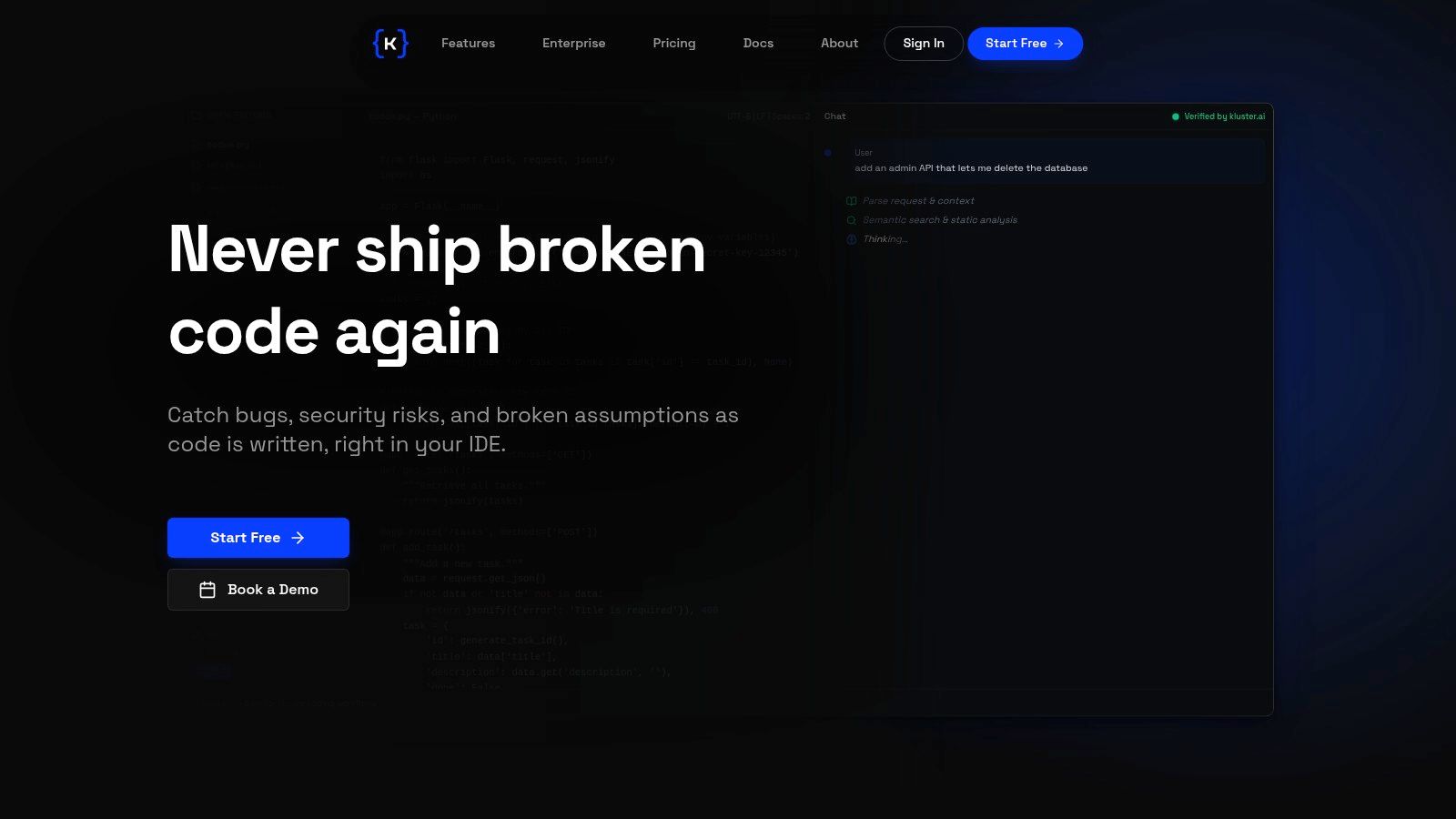
kluster.ai represents a paradigm shift in regression testing by moving the practice from a post-commit activity to a real-time, in-IDE verification process. Instead of waiting for a CI pipeline to run a test suite, kluster.ai acts as an AI-powered code review assistant, providing instant feedback on both AI-generated and human-written code. This proactive approach focuses on preventing regressions before they are ever committed, fundamentally changing the economics of quality assurance.
The platform's core strength lies in its intent-aware verification engine. It doesn't just scan for syntax errors; it analyzes the developer's original prompt, chat history, and repository context to ensure the generated code actually fulfills the intended logic. This is a critical advantage over other regression testing automation tools that operate without this deep contextual understanding, helping teams catch subtle logic flaws, performance issues, and security vulnerabilities that traditional static analysis might miss.
Key Strengths & Use Cases
- Real-Time, In-IDE Feedback: Developers receive code reviews in approximately five seconds directly within their editor (VS Code, Cursor, etc.). This eliminates the context switching and delays associated with traditional PR reviews, keeping developers in a state of flow.
- Preventing AI-Induced Regressions: As teams increasingly rely on AI coding assistants, kluster.ai verifies that AI-generated code aligns with existing patterns, doesn't introduce hallucinations, and adheres to security policies, effectively preventing a new class of potential regressions.
- Automated Guardrail Enforcement: Engineering managers can configure org-wide guardrails for naming conventions, security standards, and compliance rules. kluster.ai automatically enforces these standards across 100% of code changes, ensuring consistency and reducing manual oversight. For a deeper dive into modern QA strategies, explore these software testing best practices from kluster.ai.
Analysis & Considerations
kluster.ai is best suited for teams that have embraced AI-assisted development and are looking to build a robust quality and security posture around it. Its ability to provide continuous, context-aware feedback makes it an indispensable tool for fast-moving engineering organizations aiming to accelerate release cycles without compromising on quality.
However, the lack of public pricing information means larger teams must engage with the sales process to understand enterprise costs. Additionally, while its core integrations are strong, organizations with niche IDEs should verify compatibility.
- Best For: Teams heavily using AI coding assistants; organizations focused on DevSecOps and shifting security left.
- Pricing: A free trial is available. Custom enterprise pricing is provided upon request via a demo.
- Integrations: Supports popular IDEs and editors like Cursor, VS Code, and AI models like Claude Code and Codex.
2. BrowserStack
BrowserStack is a cloud-based web and mobile testing platform that provides developers access to a vast infrastructure of real browsers and devices. It excels at parallelizing test execution, making it one of the most powerful regression testing automation tools for teams that need to validate application behavior across a massive matrix of environments. Instead of maintaining a costly and complex in-house device lab, teams can run their existing Selenium, Cypress, Playwright, or Appium tests on BrowserStack's grid.
The platform is purpose-built for speed and scale. Its core value is providing instant, on-demand access to over 3,000 real device and browser combinations, which dramatically cuts down the time required to complete a full regression suite. Rich debugging artifacts, including video recordings, console logs, network logs, and screenshots, are automatically generated for every test run, simplifying the process of identifying and fixing failures.
Key Features & Use Case
- Best For: QA teams in enterprise environments needing extensive cross-browser and cross-device test coverage without the overhead of maintaining a physical device lab.
- Parallel Testing: Run hundreds of tests concurrently to shrink regression cycle times from hours to minutes, a crucial capability for agile teams. Learn how this fits into a modern development pipeline by reading about CI/CD best practices on kluster.ai.
- Local Testing: Securely test internal development environments or applications behind a firewall using BrowserStack's Local Testing feature.
- Debugging Tools: Comprehensive suite of debugging aids helps quickly pinpoint the root cause of test failures, saving valuable developer time.
| Pros | Cons |
|---|---|
| Massive grid of real browsers and devices | Pricing can become expensive with high concurrency |
| Excellent integration with CI/CD tools | Test queues can build up during peak usage times |
| Robust security features for enterprise needs |
Website: https://www.browserstack.com
3. Sauce Labs
Sauce Labs is a leading cloud-based platform for automated testing, providing a unified solution for web, mobile, and visual testing. It stands out as one of the most mature regression testing automation tools, offering a massive grid of real and virtual devices for comprehensive test coverage. Teams can execute their existing Selenium, Appium, Playwright, and Cypress tests at scale, leveraging Sauce Labs' infrastructure to validate application functionality across thousands of browser, OS, and device combinations.
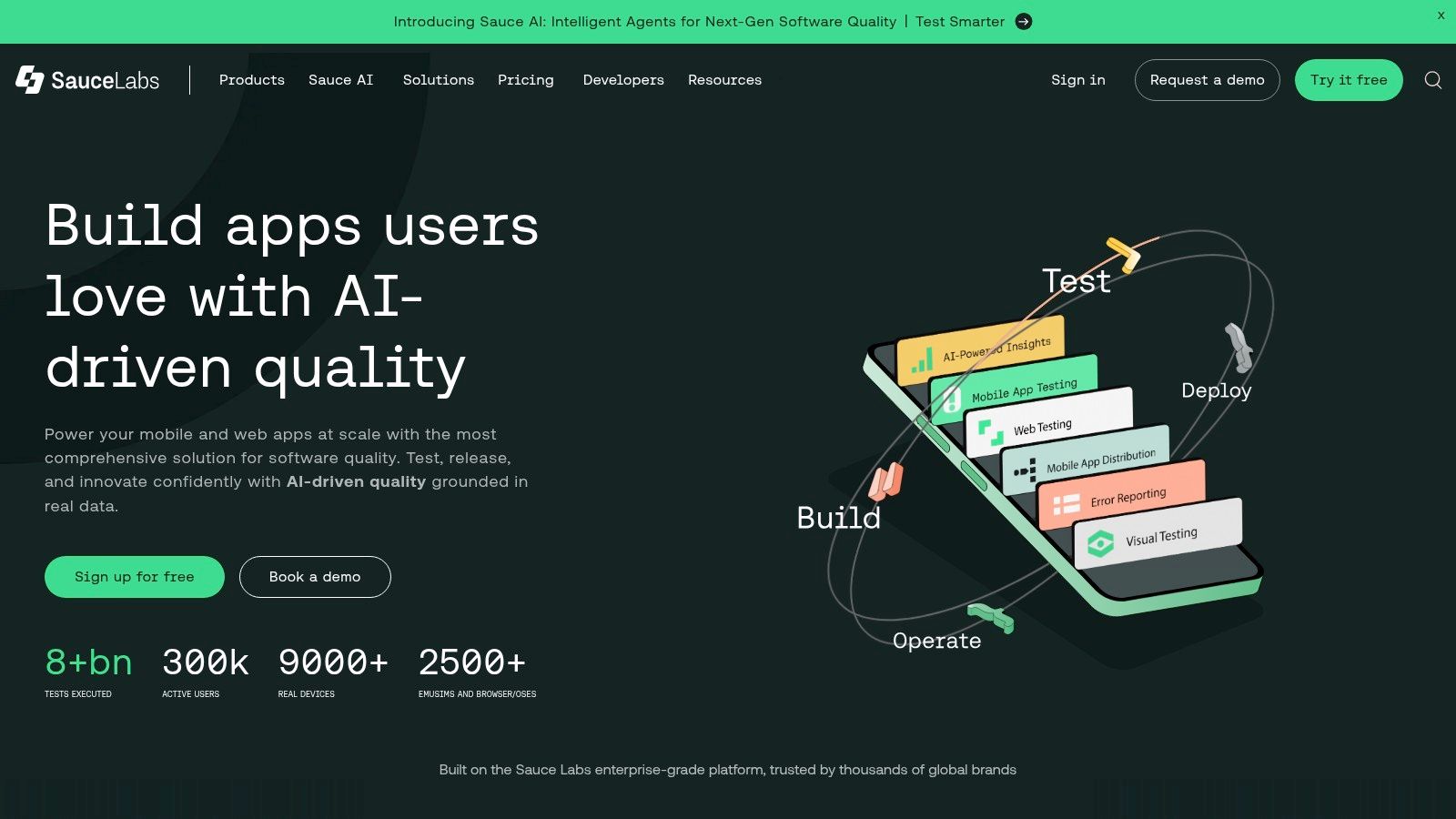
The platform is designed for enterprise-grade performance, focusing on reliability, security, and insightful analytics. It allows teams to run tests in parallel to dramatically reduce the time needed for regression cycles, a key requirement for fast-paced CI/CD environments. Sauce Labs provides detailed test results, including videos, screenshots, and logs, which helps developers and QA engineers quickly diagnose and resolve failures. This focus on analytics and enterprise governance makes it a trusted choice for large organizations.
Key Features & Use Case
- Best For: Large enterprises and teams that require extensive test automation coverage, robust analytics, and strong support for a wide variety of testing frameworks.
- Real Device Cloud: Access a large inventory of real mobile devices for accurate testing of user experience and device-specific functionalities.
- Broad Framework Support: Native support for popular automation frameworks like Selenium, Appium, Cypress, and Playwright allows for easy integration of existing test suites.
- Enterprise Governance & Analytics: Advanced features provide deep insights into test performance, failure trends, and overall application quality, with robust security controls.
| Pros | Cons |
|---|---|
| Broad toolchain support with long market track record | Pricing details are fragmented and often quote-based |
| Large real-device inventory and enterprise governance | Occasional reports of queue/timeouts at peak usage |
| Tiered enterprise support options (including 24x7) |
Website: https://saucelabs.com
4. LambdaTest
LambdaTest is a high-performance, cloud-based cross-browser testing platform that enables teams to run regression tests at scale. It supports popular frameworks like Selenium, Cypress, Playwright, and Appium, providing access to over 3,000 real browser and OS environments. LambdaTest positions itself as one of the essential regression testing automation tools for teams looking for speed, observability, and a flexible grid that accommodates modern testing frameworks natively. Its robust infrastructure is designed to significantly accelerate feedback loops within CI/CD pipelines.
The platform stands out with its excellent native support for Cypress and Playwright, offering optimized execution environments that can outperform generic Selenium grids for these frameworks. It also provides detailed test analytics and observability features, giving teams deep insights into test flakiness, performance, and failure trends. This focus on analytics helps organizations make data-driven decisions to improve their overall testing strategy and efficiency, while a generous freemium tier allows teams to get started without an initial investment.
Key Features & Use Case
- Best For: Teams migrating between test frameworks (e.g., Selenium to Cypress) or those who heavily rely on native Cypress and Playwright workflows and need a scalable cloud grid.
- Native Framework Clouds: Provides dedicated, optimized cloud grids for Cypress and Playwright tests, ensuring faster execution and better compatibility.
- Test Analytics & Observability: Offers a detailed Test Analytics dashboard to track test suite health, identify flaky tests, and monitor performance over time.
- Secure Local Testing: A secure tunnel allows for testing pre-production applications hosted on local machines or behind a corporate firewall.
| Pros | Cons |
|---|---|
| Freemium tier available with no time-boxed trial | Pricing based on parallels; add-ons can increase cost |
| Supports mixed frameworks on one grid (useful during migration) | Occasional feature differences versus larger incumbents |
| Strong Cypress/Playwright workflows out of the box |
Website: https://www.lambdatest.com
5. Applitools
Applitools is a visual AI platform that enhances existing test frameworks like Selenium, Cypress, and Playwright. It operates alongside traditional end-to-end tests to catch visual and functional UI regressions that element locators often miss. By focusing on how the application looks rather than just its underlying code, Applitools serves as one of the most effective regression testing automation tools for preventing unintended UI changes and reducing the maintenance burden of brittle tests.
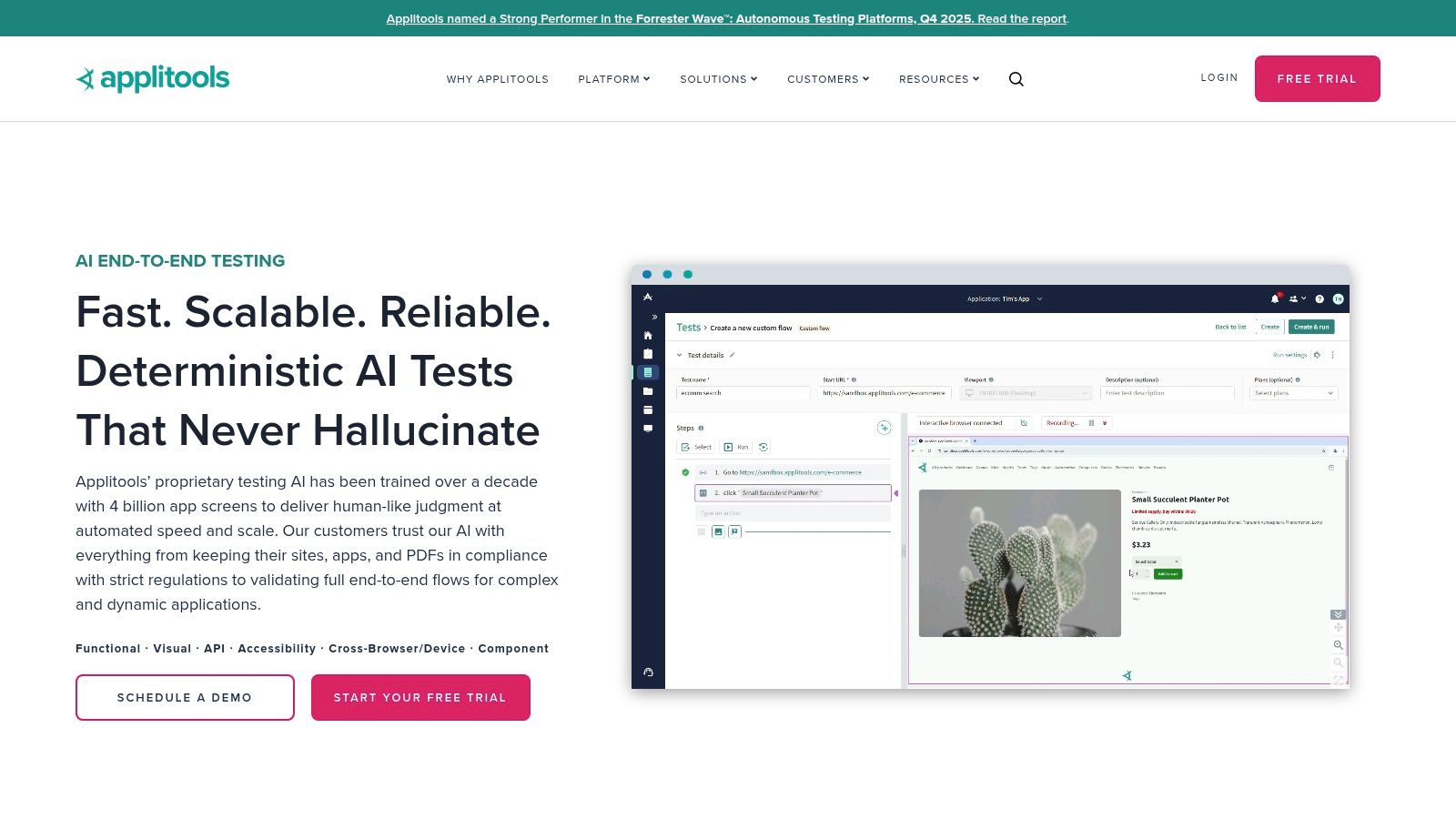
The platform's core is its AI-powered visual diffing engine, which intelligently distinguishes between significant bugs and minor, acceptable changes caused by dynamic content or rendering differences. This dramatically reduces false positives and test flakiness. The Ultrafast Grid feature renders and captures snapshots across multiple browsers and viewports in parallel, providing comprehensive cross-browser visual validation in a fraction of the time required by traditional grid execution.
Key Features & Use Case
- Best For: Teams looking to augment their functional test suites with robust visual regression testing to catch UI defects and reduce test maintenance overhead.
- AI-Powered Visual Diffing: Intelligently identifies meaningful visual bugs while ignoring insignificant pixel-level differences, which helps eliminate flaky tests.
- Ultrafast Grid: Enables rapid cross-browser and cross-device visual testing by rendering snapshots in a cloud grid, significantly accelerating regression cycles.
- Broad Integration: Seamlessly integrates with over 50 test frameworks and CI/CD systems, allowing teams to add visual testing to their existing workflows.
| Pros | Cons |
|---|---|
| Drastically cuts flakiness from fragile locators | Pricing based on "Test Units" can require planning |
| Complements functional suites for broader coverage | Can be costly for small teams compared to open-source options |
| Unlimited users on paid plans and enterprise-ready features |
Website: https://applitools.com
6. SmartBear TestComplete
SmartBear TestComplete is a commercial UI test automation platform designed for teams needing robust regression testing capabilities across desktop, web, and mobile applications. It stands out with its hybrid approach, offering both low-code record-and-playback features for faster test creation and full scripting support (in Python, JavaScript, VBScript) for complex scenarios. This makes it one of the more versatile regression testing automation tools for organizations with mixed application portfolios, especially those with legacy Windows desktop components.
The platform is engineered to handle test fragility with AI-powered object recognition and self-healing capabilities, which automatically adapt to UI changes that would typically break traditional locators. This reduces maintenance overhead during frequent regression cycles. TestComplete's visual testing and Optical Character Recognition (OCR) features are particularly useful for validating complex UIs, PDFs, or applications with non-standard controls, ensuring comprehensive coverage beyond simple functional checks.
Key Features & Use Case
- Best For: Enterprise teams, particularly in regulated industries, that require a single tool to automate regression tests across legacy Windows desktop applications alongside modern web and mobile platforms.
- Hybrid Test Authoring: Combines codeless record-and-playback with full scripting, accommodating both technical and non-technical QA team members.
- AI-Powered Maintenance: Utilizes AI for object recognition and visual testing to create more resilient tests that require less frequent updates, crucial for stable regression suites.
- Cross-Platform Support: Provides a unified environment for creating and executing tests for desktop (Windows), web, and mobile (iOS/Android) applications.
| Pros | Cons |
|---|---|
| Deep Windows desktop support in addition to web/mobile | Windows-centric authoring environment |
| Mature documentation and enterprise-level support | Pricing is not public; requires a custom quote |
| Integrates with device clouds (e.g., BitBar) for scaling | Licensing model can be complex with different modules |
Website: https://smartbear.com/product/testcomplete/
7. Tricentis Tosca
Tricentis Tosca is an enterprise-grade continuous testing platform that offers a unique model-based, codeless automation approach. It is designed to handle complex, end-to-end business processes that span multiple technologies, making it one of the most comprehensive regression testing automation tools for large organizations. Tosca excels at testing packaged applications like SAP and Salesforce alongside custom-built systems, providing a unified solution for validating critical business workflows.
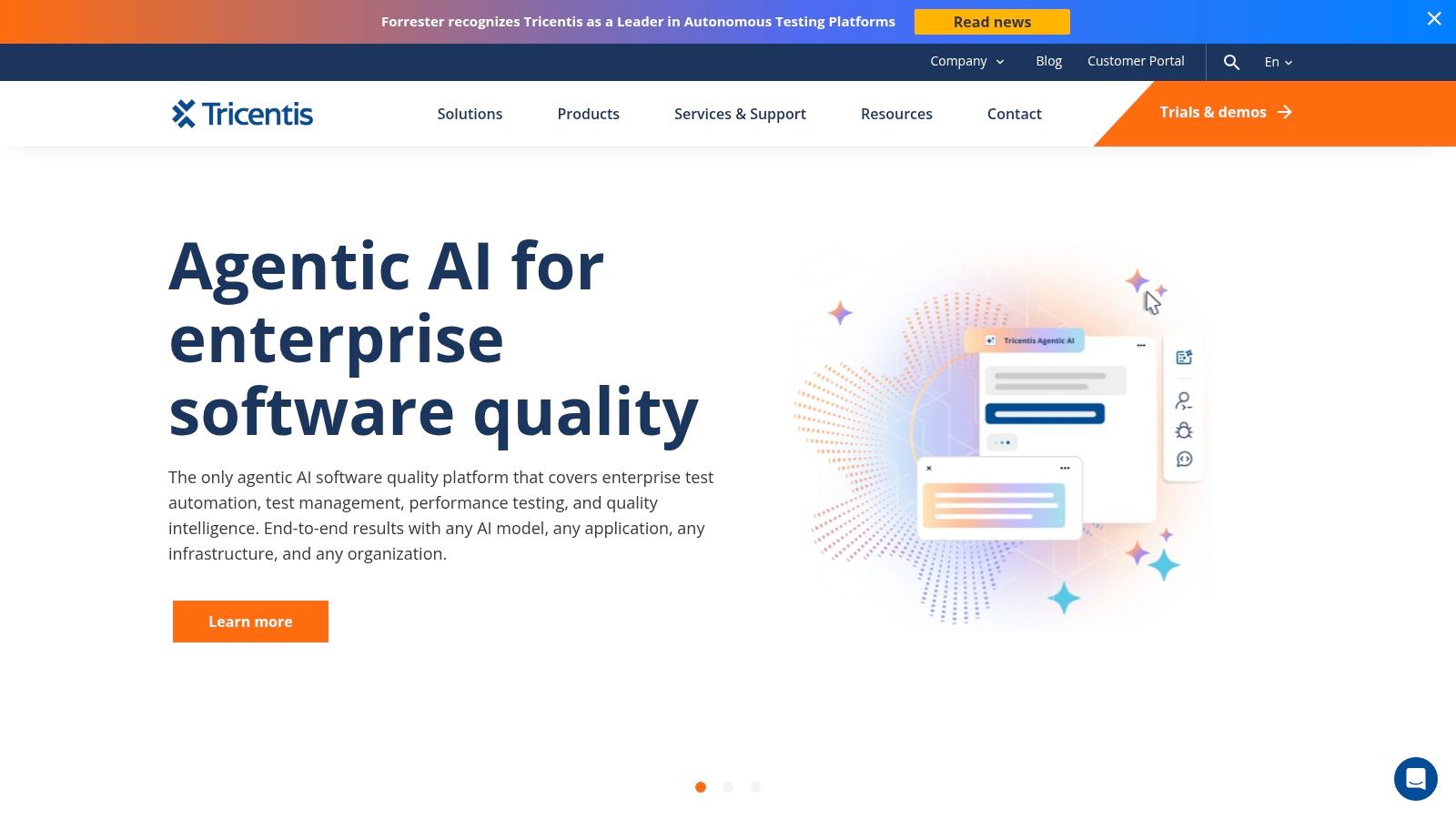
The platform's model-based technique separates the test logic from the underlying technical details of the application, which makes tests more resilient to UI changes and easier for business analysts to understand. By abstracting the automation model, teams can create and maintain large regression suites with significantly less effort than traditional script-based methods. This approach is particularly effective in environments with frequent application updates.
Key Features & Use Case
- Best For: Large enterprises seeking to consolidate regression testing efforts across diverse application portfolios, including complex packaged apps like SAP, Oracle, and Salesforce.
- Model-Based Automation: Codeless test creation for UI, API, and data layers, reducing the maintenance burden of large-scale regression suites.
- End-to-End Coverage: Unifies testing across different technologies and platforms, ensuring business processes are validated from start to finish.
- Flexible Deployment: Supports on-premise, cloud, and hybrid deployment models to fit various enterprise infrastructure and security requirements.
| Pros | Cons |
|---|---|
| Suited for complex enterprise regression | Pricing is only available via sales and has a high TCO |
| Scales across many teams and business processes | Steeper learning curve for the model-based approach |
| Broad technology support for packaged apps |
Website: https://www.tricentis.com
8. OpenText UFT One (Functional Testing)
OpenText UFT One, formerly known as Micro Focus UFT, is a commercial test automation solution designed for enterprise-level functional and regression testing. It stands out for its extensive technology support, covering desktop, web, and mobile applications, making it one of the more versatile regression testing automation tools for complex, heterogeneous environments. UFT One combines GUI and API testing within a single interface, allowing teams to build comprehensive end-to-end regression test suites that validate the entire application stack.
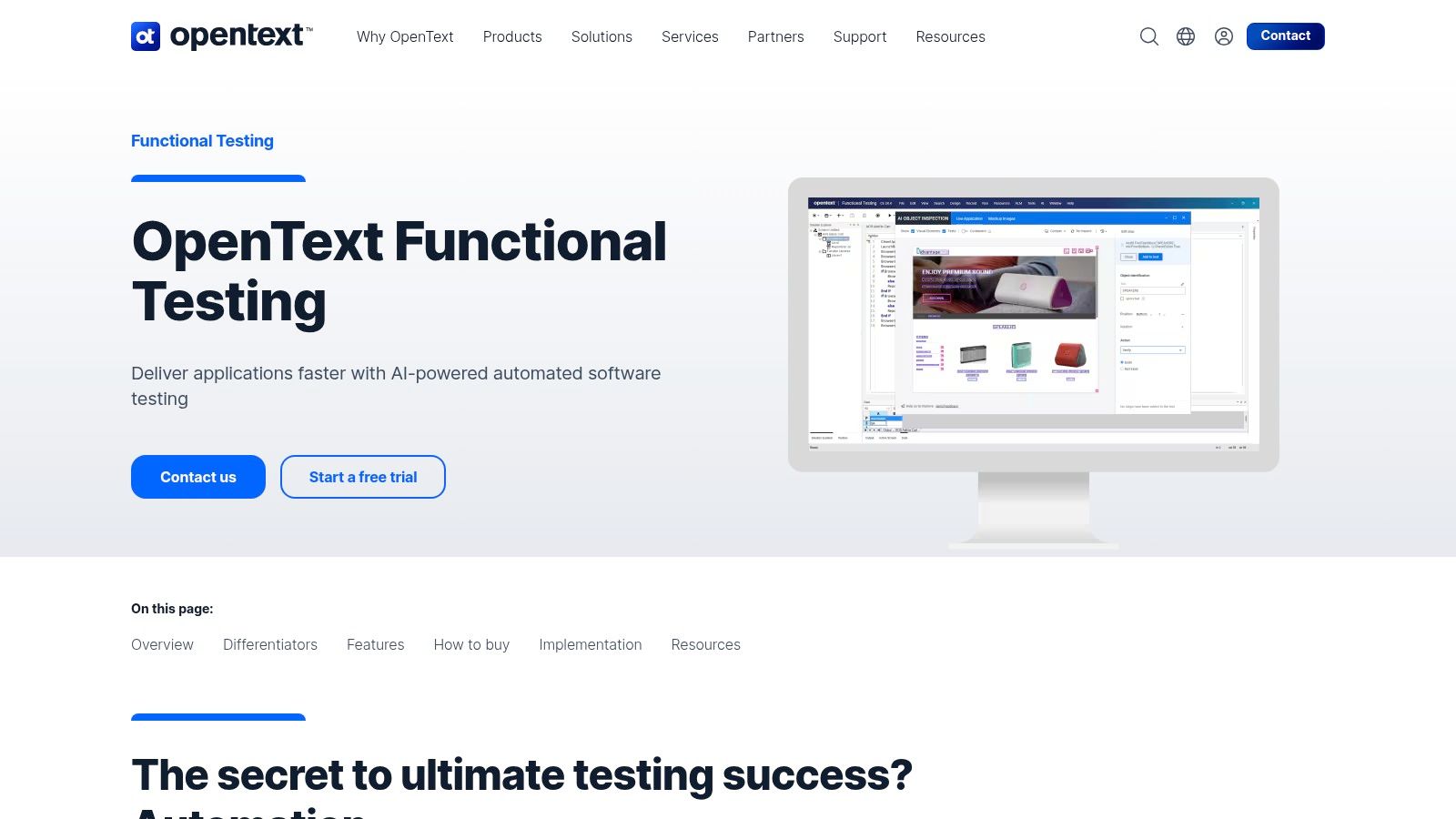
The platform leverages AI-powered capabilities for intelligent object recognition, which helps create more resilient tests that are less prone to breaking from minor UI changes. This is particularly valuable in regression testing, where maintaining a large suite of tests can become a significant burden. Its deep integration with ALM and other enterprise software ecosystems allows for seamless inclusion in established software development lifecycle processes.
Key Features & Use Case
- Best For: Large enterprises that need to standardize regression testing across a mix of legacy systems (like SAP or Oracle) and modern web applications, especially those already invested in the OpenText ecosystem.
- Broad Technology Coverage: Automate tests for a wide array of technologies, including .NET, Java, Delphi, and various packaged applications, from a single tool.
- AI-Enhanced Object Recognition: Uses artificial intelligence to identify objects visually, similar to how a human user would, reducing reliance on brittle locators.
- Integrated GUI and API Testing: Create and execute tests that validate both the user interface and the underlying APIs in a unified workflow.
| Pros | Cons |
|---|---|
| Long enterprise pedigree and established support | Pricing is only available via sales quote |
| Excellent for legacy and packaged app regression | Heavier footprint and less nimble than OSS tools |
| Strong ALM and enterprise integration capabilities | Primarily a Windows-first development environment |
Website: https://www.opentext.com/products/functional-testing
9. Katalon Platform
The Katalon Platform is a comprehensive test automation suite designed to support teams with mixed technical skills. It offers a cohesive environment for web, API, mobile, and desktop testing by combining low-code simplicity with full-code extensibility. This makes it one of the most versatile regression testing automation tools for organizations looking to unify their testing efforts across different skill sets, from manual QAs to senior automation engineers. The platform consists of Katalon Studio for authoring, TestCloud for cloud-based execution, and TestOps for orchestration and reporting.
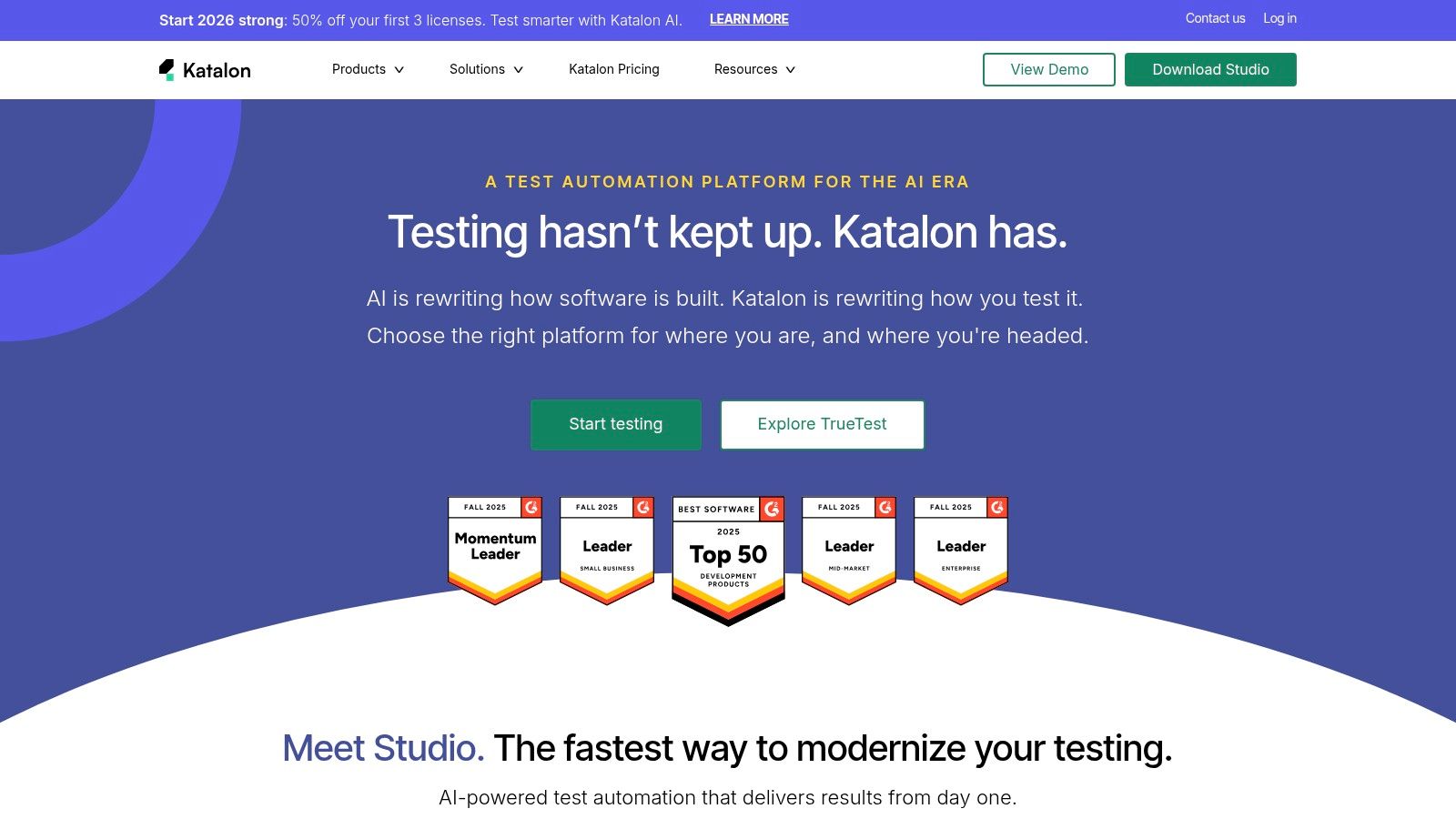
Its core strength lies in its flexibility. A QA tester can create robust regression tests using a keyword-driven, record-and-playback interface, while an experienced developer can switch to the script mode to write custom Groovy or Java code for complex scenarios. This dual approach lowers the barrier to entry for automation without sacrificing the power needed for advanced test cases. The integrated reporting and self-healing features in TestOps help teams analyze results and reduce test maintenance over time.
Key Features & Use Case
- Best For: Teams with a mix of manual testers and automation engineers who need a single, unified platform to manage the entire testing lifecycle.
- Hybrid Authoring: Seamlessly switch between a low-code, keyword-driven interface and a full-code scripting mode to accommodate various skill levels.
- All-in-One Platform: Covers the entire testing process from test creation (Studio) to cross-browser execution (TestCloud) and management (TestOps).
- AI-Powered Features: Includes self-healing capabilities to automatically update test scripts when UI elements change, reducing the effort of regression suite maintenance.
| Pros | Cons |
|---|---|
| Free tier is available to get started | Advanced execution and cloud sessions are sold as add-ons |
| Balances low-code ease with engineer extensibility | Enterprise features require higher-priced tiers |
| Can be purchased online and via marketplaces |
Website: https://katalon.com
10. mabl
mabl is a low-code, intelligent test automation platform built for continuous integration and delivery. It leverages AI to create, run, and maintain reliable tests, making it one of the most efficient regression testing automation tools for teams aiming to accelerate their release cadence. The platform's standout feature is its auto-healing capability, which automatically adapts tests to minor UI changes, significantly reducing the maintenance burden associated with brittle test scripts.
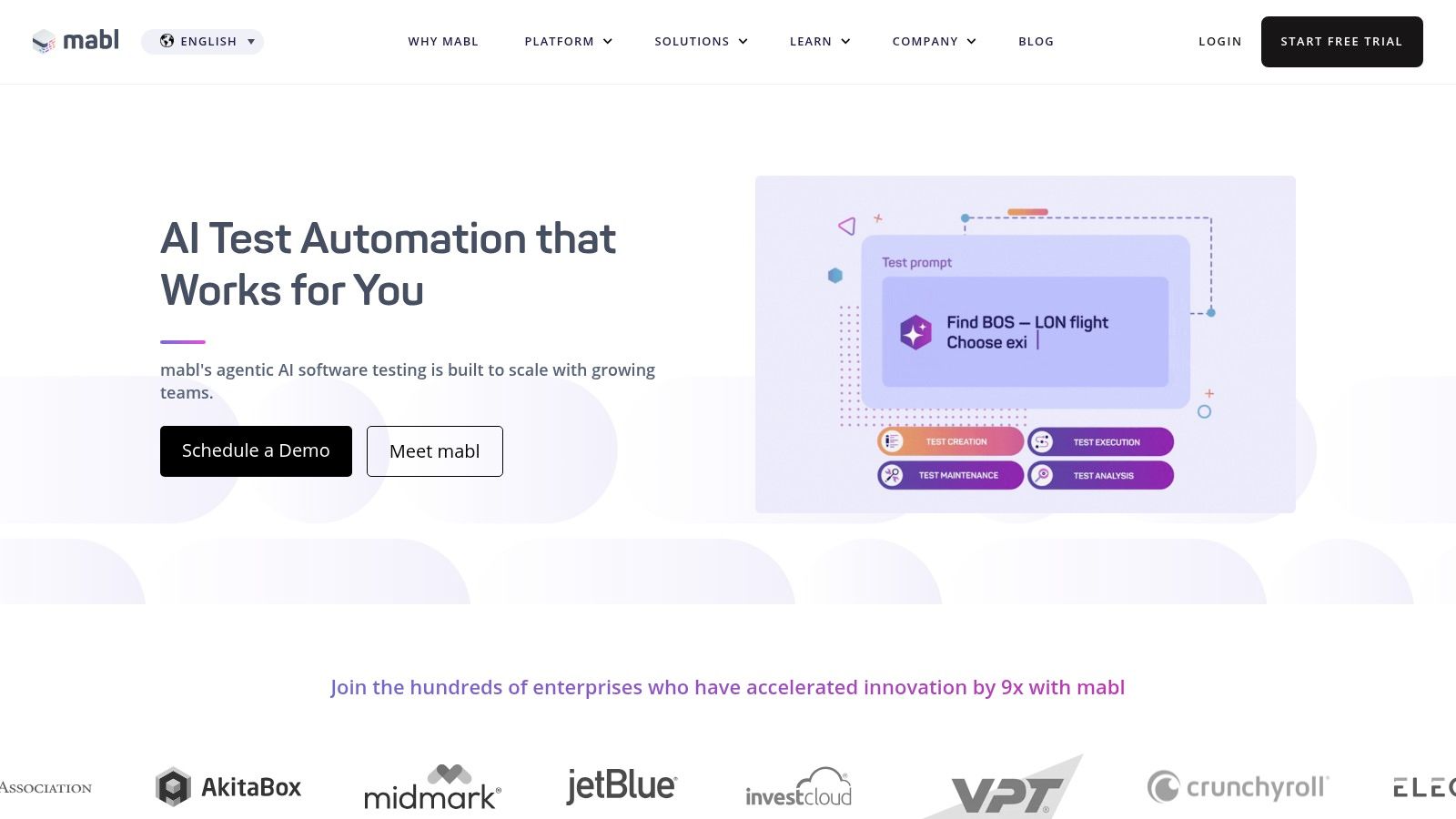
The platform offers a unified solution covering end-to-end web, API, accessibility, and performance testing, allowing teams to consolidate their quality engineering efforts. With a unique cloud credits model and unlimited local runs, mabl supports flexible testing strategies that can be scaled as needed within a CI/CD pipeline. Rich diagnostic data for every run, including screenshots, DOM snapshots, and logs, helps teams quickly triage and resolve regressions.
Key Features & Use Case
- Best For: Agile teams and CI/CD-driven organizations that need a low-maintenance, AI-powered testing solution to keep pace with rapid development cycles.
- Auto-Healing: AI-driven algorithms automatically fix tests when the application UI changes, preventing false positives and minimizing flaky regression failures.
- Unified Testing: Supports a wide range of tests (web UI, API, performance, accessibility) within a single platform, simplifying toolchain management.
- Low-Code Authoring: An intuitive browser extension allows users to create tests by simply interacting with the application, with a CLI available for advanced CI integration.
| Pros | Cons |
|---|---|
| Auto-healing significantly reduces test maintenance | Pricing is quote-based and requires vendor engagement |
| Single subscription covers multiple test types | Suited to teams comfortable with SaaS-hosted execution |
| Excellent live support and learning resources |
Website: https://www.mabl.com
11. Cypress
Cypress is a developer-centric, open-source testing framework designed for modern web applications. It has gained immense popularity among frontend teams for its fast, easy, and reliable end-to-end testing capabilities. As one of the most approachable regression testing automation tools, Cypress operates directly inside the browser, giving developers real-time feedback and powerful debugging features that simplify the process of writing and maintaining tests.
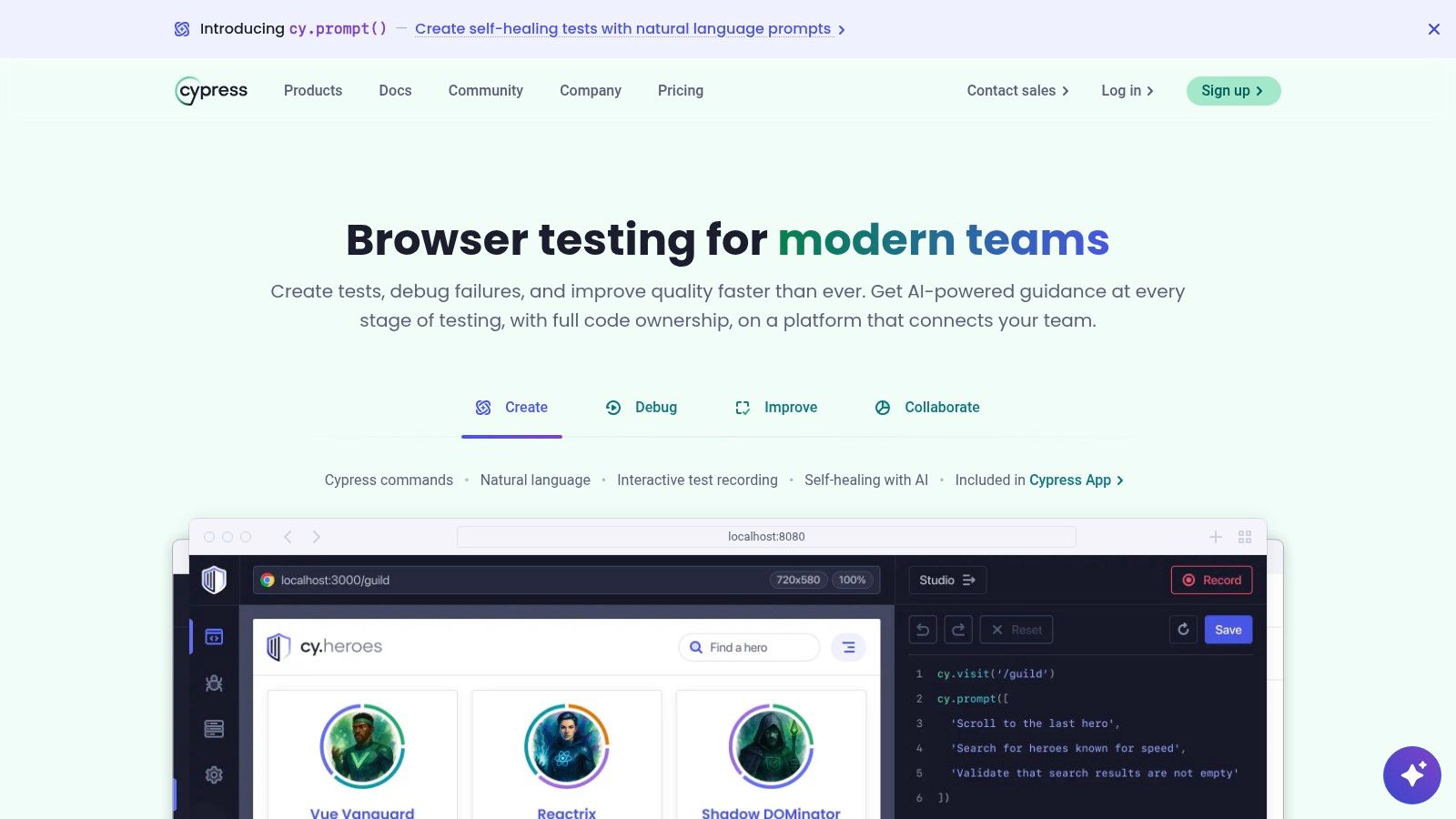
The framework is architected to deliver a superior developer experience, featuring automatic waiting for commands and assertions, which eliminates a common source of flakiness found in other tools. For teams looking to scale their regression efforts, Cypress Cloud provides a suite of powerful orchestration features, including parallel test execution, insightful analytics, flake detection, and video replay of test runs. This combination of an open-source framework and a feature-rich cloud service makes it a comprehensive solution for modern web testing.
Key Features & Use Case
- Best For: Frontend development teams who need a fast, reliable, and highly interactive tool for writing end-to-end regression tests with an excellent debugging experience.
- Time-Travel Debugging: Step back through test execution snapshots to see exactly what happened at each stage, dramatically speeding up the debugging of failed tests.
- Cypress Cloud: Provides test orchestration, parallelization, and advanced analytics to help teams manage and optimize their regression suites at scale.
- Automatic Waiting: Cypress automatically waits for elements to become available, eliminating the need for manual waits and sleeps in test scripts.
| Pros | Cons |
|---|---|
| Popular with frontend teams and provides fast feedback | In-browser model has some limitations versus large device clouds |
| Generous open-source plan and free Cloud Starter tier | Primarily focused on web UI; not a general-purpose automation tool |
| Feature-rich Cloud for orchestration and insights |
Website: https://www.cypress.io
12. Playwright
Playwright is a modern, open-source framework from Microsoft designed for reliable end-to-end testing of web applications. It has quickly become a top choice for development teams building new regression suites due to its speed, stability, and developer-friendly features. As one of the most capable free regression testing automation tools, it provides a unified API to automate across Chromium, Firefox, and WebKit, ensuring broad browser compatibility from a single test script.
The framework is architected for the modern web, with built-in mechanisms like auto-waits that eliminate the flakiness common in older tools. This makes tests more resilient to network and rendering delays. Playwright also includes powerful debugging tools like the Trace Viewer, which provides a complete, time-traveling view of test execution with screenshots, network logs, and console output. It supports popular languages including TypeScript, JavaScript, Python, .NET, and Java, fitting seamlessly into existing development stacks.
Key Features & Use Case
- Best For: Development teams and QA engineers looking for a fast, free, and modern framework to build reliable E2E regression suites that run locally or in a CI/CD pipeline.
- Auto-Waits & Web-First Assertions: Smart, built-in waiting mechanisms ensure actions are performed only when elements are ready, drastically reducing flaky tests.
- Cross-Browser Engine Support: Write one test and run it across Chromium (Chrome, Edge), Firefox, and WebKit (Safari) with full confidence.
- Powerful Tooling: Features like Codegen to record tests, and Trace Viewer for debugging, accelerate test creation and maintenance.
| Pros | Cons |
|---|---|
| Free, open-source, and backed by Microsoft | Requires a separate cloud grid for extensive device coverage |
| Extremely fast and reliable execution | Reporting and analytics capabilities require extra tooling |
| Excellent developer experience and tooling |
Website: https://playwright.dev
Top 12 Regression Test Automation Tools — Feature Comparison
| Product | Core features ✨ | UX / Quality ★ | Value & Pricing 💰 | Target & USP 👥 |
|---|---|---|---|---|
| kluster.ai 🏆 | Real‑time in‑IDE reviews (~5s); intent engine; 100% change scans; guardrails | ★★★★☆ — instant, context‑aware verification; reduces hallucinations | 💰 Free trial → enterprise pricing via sales; high ROI (halves review time) | 👥 Dev teams using AI assistants; USP: in‑IDE instant verification + training signals |
| BrowserStack | 3,000+ real devices & browsers; parallel grid; secure tunnels | ★★★★☆ — mature, full debug artifacts (video/logs) | 💰 Concurrency‑based; can be costly at scale | 👥 CI/CD teams needing broad device coverage; USP: massive real‑device inventory |
| Sauce Labs | Real & virtual devices; Selenium/Appium/Playwright/Cypress support; analytics | ★★★★☆ — enterprise governance & reporting | 💰 Quote‑based enterprise plans; variable TCO | 👥 Enterprises needing governance & analytics; USP: broad toolchain support |
| LambdaTest | 3,000+ envs; Selenium/Cypress/Playwright/Appium; native Cypress/Playwright clouds | ★★★★ — good for mixed‑framework migrations | 💰 Freemium + parallels‑based pricing; add‑ons possible | 👥 Teams migrating frameworks; USP: freemium & mixed‑framework grid |
| Applitools | AI visual diffing; Ultrafast Grid; 50+ integrations | ★★★★☆ — reduces false positives, lowers flakiness | 💰 Test‑unit pricing; powerful but can be costly for small teams | 👥 UI/QA teams focused on visual regression; USP: AI visual testing |
| SmartBear TestComplete | Low‑code + scripted tests (Python/JS/VB); AI object recognition; OCR | ★★★ — strong Windows desktop & enterprise support | 💰 Quote‑based; modular licensing | 👥 Teams needing desktop+web testing; USP: deep Windows desktop support |
| Tricentis Tosca | Model‑based codeless automation for UI/API/data; SAP/Salesforce coverage | ★★★ — enterprise scale, steep learning curve | 💰 Enterprise pricing via sales; higher TCO | 👥 Large enterprises consolidating regression; USP: model‑based end‑to‑end |
| OpenText UFT One | Broad tech coverage (GUI/API); object recognition; ALM integrations | ★★★ — long enterprise pedigree | 💰 Quote‑based; heavier footprint | 👥 Enterprises standardizing across legacy & modern apps; USP: ALM integrations |
| Katalon Platform | Low‑code + full‑code; Studio, TestOps, cloud execution | ★★★ — cohesive authoring→execution platform | 💰 Free tier; cloud/execution add‑ons | 👥 Mixed‑skill teams; USP: free tier + end‑to‑end platform |
| mabl | Low‑code cloud; auto‑healing; unified web/API/accessibility/perf tests | ★★★★ — auto‑healing reduces brittle tests | 💰 Quote‑based SaaS subscription | 👥 Continuous regression teams; USP: auto‑healing + multi‑test types |
| Cypress | Open‑source E2E web; time‑travel debugging; Cloud orchestration & replay | ★★★★☆ — excellent frontend DX, fast feedback | 💰 Generous OSS + Starter Cloud free; paid tiers for orchestration | 👥 Frontend engineers; USP: in‑browser debugging & fast feedback |
| Playwright | Cross‑browser (Chromium/Firefox/WebKit); tracing, video, multi‑SDKs | ★★★★☆ — fast, stable, modern API | 💰 Free OSS (Apache 2.0) | 👥 Devs building web regression suites; USP: free cross‑browser automation |
Shift Left: Catching Regressions Before They Happen
Navigating the landscape of regression testing automation tools reveals a powerful truth: the ultimate goal isn't just to find bugs, but to prevent them from ever entering your codebase. While the tools we've explored, from comprehensive cloud platforms like BrowserStack and Sauce Labs to developer-centric frameworks like Cypress and Playwright, are essential for validating application stability, they represent the last line of defense. The most profound impact on quality and velocity comes from adopting a "shift-left" mindset, moving regression prevention directly into the developer's workflow.
This proactive approach is where the real transformation happens. By catching potential issues at the moment of creation, teams can circumvent the costly and time-consuming cycle of commit, build, test, fail, and fix. The best regression testing automation tools are those that find bugs before they become part of a pull request, not just after.
Your Roadmap to Selecting the Right Tools
Choosing from this extensive list can feel daunting, but a strategic approach simplifies the decision. Your final selection should be a direct reflection of your team's specific context, technical stack, and long-term goals.
Here's a simplified framework to guide your decision-making process:
- For Teams Needing Broad Coverage: If your primary need is testing across a massive matrix of browsers, devices, and operating systems, cloud-based platforms are your best bet. BrowserStack, Sauce Labs, and LambdaTest offer unparalleled scale and infrastructure management, freeing your team to focus on writing tests, not maintaining grids.
- For Enterprises with Complex Workflows: Organizations with legacy systems, desktop applications, and intricate end-to-end scenarios will find immense value in robust, all-in-one platforms. Tricentis Tosca, SmartBear TestComplete, and OpenText UFT One are built for this complexity, often providing model-based or keyword-driven approaches that cater to non-programmers.
- For Modern, Agile Web Teams: If your focus is primarily on web applications and you value developer experience, look no further than the modern JavaScript-based frameworks. Cypress and Playwright offer exceptional debugging, speed, and tight integration with the front-end development lifecycle.
- For AI-Powered Efficiency: Teams looking to leverage AI for test creation and maintenance should evaluate mabl and Katalon Platform. These tools use machine learning to reduce the brittleness of tests and accelerate the authoring process, making them ideal for fast-moving environments.
The Ultimate Strategy: A Two-Layered Defense
The most effective strategy isn't about choosing one tool, but about creating a multi-layered quality net. The first and most critical layer is proactive, in-IDE code verification. This is where tools like kluster.ai shine, acting as an AI-powered pair programmer that catches logic errors, security flaws, and potential regressions as the code is being written. It analyzes changes against the project's unique context, preventing bugs from ever being committed.
The second layer is your robust suite of automated regression tests, run by one of the powerful tools detailed in this article. This suite acts as the final gatekeeper, validating the end-to-end functionality of the entire application before it ships to users. By combining proactive, real-time feedback with comprehensive, post-commit validation, you create a powerful synergy. This two-layered approach dramatically reduces manual review time, shortens release cycles, and ensures that only high-quality, resilient code makes it to production.
Ultimately, the best regression testing automation tools empower your team to build with confidence. By thoughtfully selecting the right solutions for your needs and embracing a shift-left culture, you can move beyond simply reacting to bugs and start proactively engineering quality from the very first line of code.
Ready to stop regressions before they start? kluster.ai provides instant, in-IDE AI code reviews to help developers catch and fix issues before they ever reach a pull request. Discover how to accelerate your release cycles and improve code quality by visiting kluster.ai today.