

10 Code Review Best Practice Principles for AI-Assisted Teams in 2025
In a world where AI assistants generate code in seconds, the traditional pull request (PR) model is starting to show its age. Long waits, context switching, and manual nitpicking create bottlenecks that undermine the very speed AI promises. The challenge isn't just about reviewing code anymore; it's about verifying AI-generated output in real-time and ensuring it aligns with project standards, security policies, and the developer's original intent. Sticking to an outdated review process means you're not just slowing down delivery, you're also risking the introduction of subtle, AI-generated bugs, security flaws, and inconsistent architectural patterns into your codebase.
This article outlines the essential code review best practice principles for modern teams using AI-assisted coding tools. We move beyond generic advice to provide a concrete, actionable framework for the entire review lifecycle. You will learn how to adapt your processes to eliminate PR ping-pong, catch AI hallucinations before they become bugs, and transform your review culture into a streamlined engine for shipping high-quality, production-ready code faster than ever.
We will cover a comprehensive set of strategies, including:
- Establishing clear, enforceable standards for both human and AI-generated code.
- Integrating automated checks to validate quality, security, and compliance directly within the IDE.
- Fostering a review etiquette that prioritizes constructive feedback and shared learning.
- Defining clear roles, responsibilities, and timelines to keep the review process moving.
By implementing a modern code review best practice framework, your team can harness the full potential of AI-driven development without sacrificing quality or security. This guide provides the tactical steps needed to build a more efficient, collaborative, and resilient engineering workflow.
1. Establish Clear Code Review Standards and Guidelines
The most effective code review process is built on a foundation of clear, objective standards. Before any code is submitted for review, your team must define and document explicit guidelines covering everything from syntax and style to architectural patterns and performance benchmarks. This critical first step transforms subjective debates into objective assessments, making the entire code review best practice more efficient and less prone to conflict.
Clear standards provide a single source of truth that both the author and the reviewer can reference. This eliminates guesswork and ensures that feedback is consistent, relevant, and aligned with team-wide goals. When everyone understands what "good" code looks like, reviews become faster, more focused, and ultimately more valuable.
Why It's a Top Practice
Without established guidelines, code reviews often devolve into personal preference debates. One developer might prefer camelCase for variable names, while another insists on snake_case. These discussions waste time and create friction. Documented standards resolve these issues preemptively, allowing reviewers to concentrate on more significant concerns like logic, security, and scalability.
How to Implement Clear Standards
Implementing this practice involves more than just writing a document; it requires integration into your team's daily workflow.
- Adopt or Create a Style Guide: Don't reinvent the wheel if you don't have to. Adopt well-regarded industry standards like Google's Style Guides, Python's PEP 8, or Airbnb's JavaScript Style Guide as a starting point. Customize them to fit your team's specific needs.
- Automate Enforcement: Use tools like linters (ESLint, Pylint) and code formatters (Prettier, Black) to automatically enforce stylistic rules. This catches minor issues before the review even begins, freeing up human reviewers for more complex analysis.
- Make Guidelines Accessible: Store your standards document directly in your repository (e.g., as
CONTRIBUTING.md) or in a shared, easily accessible wiki like Confluence. - Create a Review Checklist: A checklist ensures all essential criteria are evaluated consistently. This can be especially useful for creating a comprehensive and effective pull request checklist.
- Review and Update Regularly: Host a quarterly meeting to discuss, refine, and update your coding standards based on new technologies, team feedback, and evolving project requirements. This keeps the guidelines relevant and encourages team buy-in.
2. Keep Code Reviews Small and Focused
A fundamental code review best practice is to ensure that every pull request (PR) is small, atomic, and centered on a single, well-defined task. When a developer submits a massive PR with thousands of lines of code spanning multiple features, the review process grinds to a halt. Reviewers face a daunting task, making it nearly impossible to provide thorough feedback and significantly increasing the risk of overlooking critical bugs, security flaws, or architectural issues.
By contrast, small and focused changes are easier to understand, faster to review, and simpler to merge. This approach creates a rapid feedback loop, allowing teams to iterate quickly and maintain a high velocity without sacrificing code quality. The goal is to make each review a manageable, focused exercise rather than an exhaustive expedition through complex code.

Why It's a Top Practice
Large code reviews suffer from a phenomenon known as "review fatigue." Faced with an overwhelming amount of code, a reviewer's ability to spot errors diminishes significantly. Research from companies like Google has shown that review quality plummets as the number of lines of code increases. Keeping reviews small respects the cognitive load of your teammates and ensures that each line of code receives the attention it deserves. This practice directly leads to higher-quality code, faster deployment cycles, and a more collaborative review culture.
How to Implement Small, Focused Reviews
Integrating this practice requires a disciplined approach to task breakdown and a commitment from the entire team to maintain small, incremental changes.
- Establish a PR Size Limit: Agree on a soft or hard limit for PRs. Many engineering teams, including those at GitHub, suggest that reviews under 400 lines of code are optimal for speed and thoroughness. This provides a clear, measurable guideline.
- Break Down Large Features: Before writing any code, plan how to split a large feature or epic into smaller, logical, and independently shippable chunks. Each chunk should result in its own focused PR.
- Use Feature Flags: For features that cannot be released in small parts, use feature flags. This allows you to merge incomplete or dependent code into the main branch without exposing it to users, enabling continuous integration with small PRs.
- Separate Refactoring from Features: Avoid mixing functional changes with large-scale refactoring in the same PR. If you need to refactor a file, do it in a separate, dedicated PR before or after implementing the new feature. This keeps the review focused on one type of change at a time.
3. Implement Automated Code Quality Checks
Automating routine checks is a cornerstone of any modern code review best practice. Instead of relying on human reviewers to catch mechanical issues like syntax errors, stylistic inconsistencies, or missing test coverage, teams can delegate these tasks to automated tools. This frees up developers' cognitive capacity to focus on what truly matters: the underlying logic, architectural soundness, and overall maintainability of the code.
By integrating automated quality gates into the development pipeline, you create a consistent, objective first line of defense. These tools act as tireless gatekeepers, ensuring that every submission meets a baseline quality standard before it ever reaches a human reviewer. This not only saves significant time but also reduces friction by handling objective feedback programmatically.
Why It's a Top Practice
Human reviewers are fallible and can easily miss minor issues when focused on complex business logic. Automation excels at catching these repetitive, pattern-based errors with perfect consistency. Enforcing these checks automatically removes the burden from developers, prevents bikeshedding over trivialities, and allows peer reviews to be a high-level discussion about design and impact rather than a nitpicking session.
How to Implement Automated Checks
Integrating automation effectively requires a multi-layered approach that provides feedback early and often in the development lifecycle.
- Configure Linters and Formatters: Establish a team-wide configuration for tools like ESLint, Pylint, and Prettier. These tools enforce coding style and catch common programming errors directly in the developer's environment.
- Use Pre-Commit Hooks: Implement pre-commit hooks using tools like Husky or
pre-committo run automated checks locally before a developer can even commit their code. This catches issues at the earliest possible stage. - Set Up Branch Protection Rules: In platforms like GitHub or GitLab, configure branch protection rules to require that all automated checks (like builds, tests, and security scans) pass before a pull request can be merged.
- Integrate Static and Dynamic Analysis: Incorporate Static Application Security Testing (SAST) and Dynamic Application Security Testing (DAST) tools into your CI/CD pipeline to automatically scan for security vulnerabilities.
- Monitor Test Coverage: Use tools like Codecov or Coveralls to automatically report on test coverage and set quality gates that prevent merging code that reduces overall coverage below a certain threshold. For a deeper dive, explore these code review automation tools.
4. Encourage Constructive and Respectful Communication
The technical quality of code is important, but the human element of a code review is what truly defines its success. An effective code review best practice is one that fosters a culture where reviews are seen as collaborative learning opportunities, not personal criticisms. The goal is to build psychological safety, allowing authors and reviewers to engage openly without fear of judgment. This transforms feedback from a point of contention into a catalyst for growth and team cohesion.
This approach ensures that conversations are centered on the code's merits and aligned with team goals, rather than personal coding styles. When team members feel respected, they are more receptive to feedback, more willing to ask questions, and ultimately more engaged in producing high-quality work together.

Why It's a Top Practice
A toxic or adversarial review culture can quickly demoralize a team, leading to slower reviews, hidden bugs, and increased developer turnover. Research like Google's Project Aristotle has shown that psychological safety is the single most important dynamic in high-performing teams. By prioritizing constructive communication, you create an environment where developers can innovate and take risks, knowing that the review process is there to support, not to scrutinize them personally. This leads to better code, stronger team relationships, and a more resilient engineering organization.
How to Implement Constructive Communication
Creating a positive review culture requires intentional effort and consistent reinforcement from team leadership.
- Establish Communication Guidelines: Document clear expectations for giving and receiving feedback in your team handbook. Outline what constitutes constructive versus destructive comments.
- Frame Feedback Thoughtfully: Encourage reviewers to use "I" statements and ask questions. Instead of "You did this wrong," try "I noticed this might cause an issue, what was the reasoning for this approach?"
- Praise Good Work: A good review isn't just about finding flaws. Make it a habit to point out clever solutions, clean code, and well-written tests. This reinforces positive behaviors and balances the conversation.
- Lead by Example: Team leads and senior engineers must model the desired behavior. How they provide and receive feedback sets the tone for the entire team.
- Separate the Author from the Code: Emphasize that all feedback is directed at the code, not the person who wrote it. This depersonalizes the process and helps authors remain open-minded.
5. Require Tests for All Code Changes
A fundamental code review best practice is mandating that all code submissions are accompanied by comprehensive tests. This non-negotiable rule ensures that new features work as expected and, crucially, do not break existing functionality. By embedding testing directly into the review process, teams can catch bugs early, prevent regressions, and build a more stable, maintainable codebase.
This practice shifts quality assurance left, making it a shared responsibility rather than an afterthought. When reviewers verify that changes include meaningful unit, integration, or end-to-end tests, they are not just checking for correctness; they are safeguarding the long-term health of the application. Companies like Google and AWS enforce strict testing requirements, recognizing them as essential for building scalable and reliable systems.
Why It's a Top Practice
Code without tests is inherently risky. Each modification, no matter how small, introduces the potential for unintended side effects. Requiring tests with every pull request provides a safety net, giving developers the confidence to refactor and innovate without fear of causing silent failures. It also serves as living documentation, demonstrating how the code is intended to be used.
How to Implement Required Testing
Integrating mandatory testing into your workflow requires clear expectations and the right tools to enforce them. This ensures every piece of code is validated.
- Set Minimum Coverage Thresholds: Use code coverage tools (like JaCoCo, Istanbul, or Coverage.py) to establish a baseline, often between 70-80%. This metric ensures that a significant portion of the new code is tested, but remember to prioritize quality over raw numbers.
- Review Test Quality, Not Just Quantity: During the code review, a reviewer should ask, "Do these tests genuinely validate the code's logic?" Check that tests cover edge cases, error conditions, and realistic usage scenarios, not just the "happy path."
- Automate Test Execution: Integrate your test suite into your CI/CD pipeline. Use tools like GitHub Actions or Jenkins to automatically run all tests for a pull request and block merging if any tests fail.
- Ensure Tests are Independent and Reproducible: Tests should not depend on each other or external states. Each test must be able to run independently and produce the same result every time, eliminating flaky or unreliable checks.
- Consider Mutation Testing: For mature projects, use mutation testing tools (e.g., Stryker, PITest) to assess the quality of your tests. These tools introduce small defects into your code to see if your existing tests can "kill" the mutant, thus verifying their effectiveness.
6. Set Response Time Expectations and Timelines
A pull request sitting idle is a major blocker to productivity and momentum. Establishing clear expectations for how quickly reviewers should respond to review requests is a critical code review best practice that prevents bottlenecks and keeps the development cycle moving. When authors know when to expect feedback, they can better manage their workflow and avoid context-switching, leading to faster integrations and releases.
Defining a reasonable timeline transforms the review process from a waiting game into a predictable, efficient system. It ensures that code doesn't become stale, which can lead to complex merge conflicts and rework. By setting and monitoring response times, teams can maintain a steady flow of work and support a culture of continuous delivery.
Why It's a Top Practice
Without defined timelines, code reviews can become a low-priority task that gets pushed aside for other work. This creates frustration for the author and delays the entire team's progress. A formal expectation, often framed as a Service Level Agreement (SLA), holds everyone accountable and signals that timely reviews are a shared team responsibility. It ensures that no single developer becomes a chokepoint and that the review workload is distributed fairly.
How to Implement Response Time Expectations
Implementing this practice requires clear communication and the right tools to track and enforce the standards.
- Establish a Team SLA: Define a realistic turnaround time for initial feedback. For many teams, especially those in the same time zone, a 24-hour response time is a common and effective goal. For high-priority or very small changes, this might be shortened to just a few business hours.
- Use Automation for Reminders: Integrate tools into your workflow that automatically notify reviewers of pending requests. GitHub Actions or Slack integrations can send reminders for pull requests that have been open for a certain period without a review, gently nudging the process along.
- Rotate Reviewer Assignments: To prevent burnout and distribute knowledge, implement a system for rotating review duties. This ensures no single person is constantly overwhelmed with requests and helps spread familiarity with different parts of the codebase across the team.
- Document and Communicate: Add the response time SLA to your team's official documentation, such as a "ways of working" document in Confluence or a
CONTRIBUTING.mdfile in your repository. This makes the expectation clear for current members and new hires. - Track and Discuss Metrics: Monitor key metrics like "time to first review" and "total time to merge." Discuss these numbers in team retrospectives to identify patterns or recurring bottlenecks and adjust your process or SLA as needed.
7. Have Clear Decision Authority and Approval Process
A robust code review best practice hinges on a well-defined approval process that clarifies who has the final say. Establishing clear decision authority removes ambiguity, prevents pull requests from languishing in a state of perpetual debate, and ensures changes are merged efficiently and responsibly. This framework defines who must approve a change, how many approvals are needed, and what to do when reviewers disagree.
Without this clarity, teams often face bottlenecks where changes are blocked by unresolved comments or uncertainty over who can give the final green light. A formal approval structure ensures that every piece of code meets a consistent quality bar and that accountability is clearly assigned, turning a potential point of conflict into a streamlined step in the development lifecycle.
Why It's a Top Practice
When approval authority is vague, pull requests can stall or, worse, get merged without proper vetting. This can lead to inconsistent code quality and introduce bugs into the main branch. A clear process ensures that subject matter experts and designated gatekeepers review critical changes, upholding architectural integrity and security standards. It also empowers developers by giving them a clear path to getting their work approved and merged.
How to Implement a Clear Approval Process
Integrating a formal approval workflow requires documenting rules and leveraging platform features to enforce them.
- Define and Document Authority: Use a
CODEOWNERSfile in your repository (supported by GitHub, GitLab, and Bitbucket) to automatically assign required reviewers based on which files or directories are modified. This ensures the right experts are always looped in. - Establish a Review Quorum: For critical systems like authentication or payment processing, mandate a minimum of two approvals. This "two-person rule" provides a crucial layer of redundancy and reduces the risk of a single point of failure.
- Create an Escalation Path: Document a clear procedure for resolving deadlocked reviews where reviewers cannot reach a consensus. This typically involves escalating the decision to a tech lead, an architect, or a designated module maintainer.
- Use Distinct Review Statuses: Configure your version control system to distinguish between reviews that are "comment-only" and those that constitute a formal "approval." This prevents misunderstandings and clarifies when a change is ready to merge.
- Regularly Audit Permissions: Periodically review who has merge and approval permissions. As team members change roles or leave the project, it's essential to keep the list of authorities current to maintain security and process integrity.
8. Prioritize Learning and Knowledge Sharing
An exceptional code review best practice transcends simple bug-finding; it becomes a powerful engine for team growth and knowledge dissemination. By viewing every review as an opportunity to teach and learn, you transform a procedural task into a collaborative mentorship session. This approach focuses on explaining not just what to change, but why the change is necessary, providing context, rationale, and deeper architectural insights.
This mindset cultivates a culture of continuous improvement where junior developers are actively upskilled and senior developers refine their ability to communicate complex ideas. When knowledge is shared freely, your team becomes more resilient, breaking down information silos and ensuring that critical system knowledge isn't held by just a few individuals.
Why It's a Top Practice
Code reviews that only point out errors without explanation can feel critical and unhelpful, leaving developers to guess the underlying principles. In contrast, a learning-focused review builds confidence, fosters psychological safety, and improves the team's collective skill set. It directly addresses the root cause of potential issues, ensuring the same mistakes are less likely to be repeated, which is a far more effective long-term strategy than just fixing a single instance of a problem.
How to Implement Knowledge Sharing
Integrating teaching into your review process requires a deliberate shift in how feedback is framed and delivered.
- Explain the 'Why': Instead of just saying "Use a different data structure here," explain why it's better. For example, "A
HashSetwould be more performant for this lookup than aListbecause it provides O(1) average time complexity for containment checks." - Link to Resources: If you are referencing a design pattern, a specific language feature, or a company standard, include a link to the relevant documentation, a well-regarded blog post, or an internal wiki page.
- Ask Guiding Questions: Prompt the author to think critically. Instead of giving the answer, ask, "Have you considered how this function will behave if the input array is empty? What could we do to make it more robust?"
- Pair Developers Strategically: Assign reviews where a senior developer can mentor a junior developer. This creates a direct channel for knowledge transfer and is a key component in any successful program for strategic learning and development.
- Show, Don't Just Tell: When suggesting a significant refactor, provide a small, clear code snippet demonstrating the improved pattern. This makes the abstract concept concrete and easier to understand.
9. Review Code for Design and Architecture
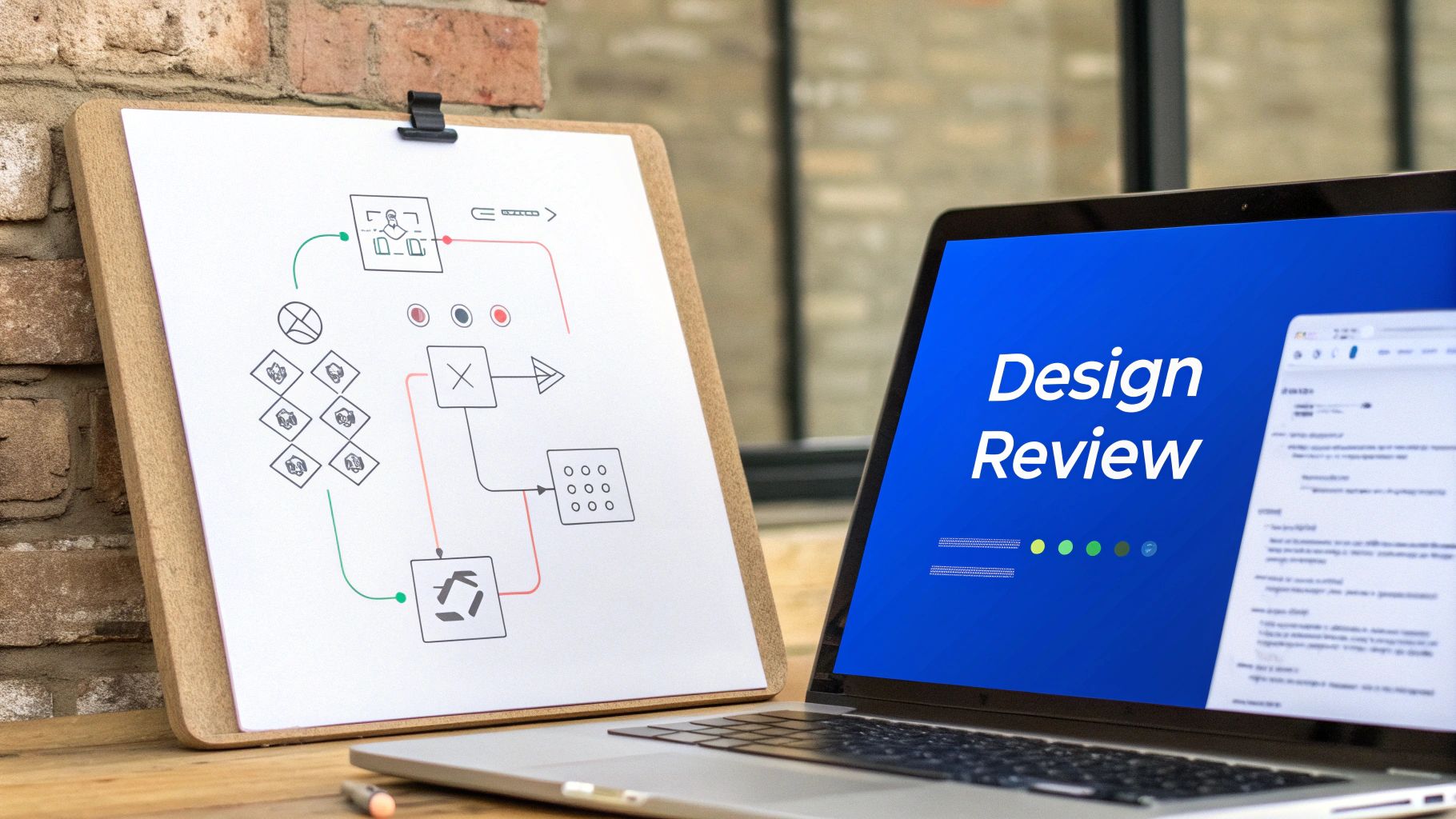
A truly effective code review best practice looks beyond surface-level syntax and functionality. It delves into the deeper layers of design and architecture, evaluating how new code integrates with the broader system. This means assessing architectural patterns, scalability, and long-term maintainability to prevent the slow accumulation of technical debt that can cripple a project over time.
This architectural oversight ensures that individual contributions don't just "work" but also align with the system's strategic goals. It's the difference between building a collection of features and engineering a cohesive, scalable, and resilient product. Companies like Netflix and Amazon embed this principle in their culture, using rigorous architecture and API design reviews to manage the complexity of their microservices.
Why It's a Top Practice
Focusing solely on immediate logic and style can lead to a system that is difficult to change, test, and scale. Architectural reviews catch systemic issues early, like introducing unnecessary dependencies or choosing a design pattern that conflicts with existing conventions. By addressing these foundational concerns during the review, teams build a more robust and maintainable codebase, saving significant time and resources in the future.
How to Implement Architectural Reviews
Integrating architectural thinking into your code review process requires a shift in mindset and a structured approach to asking the right questions.
- Ask Future-Proofing Questions: Prompt reviewers to think bigger. Encourage questions like, "How will this scale to 10x the current load?" or "Will this be easy for a new developer to modify in six months?"
- Assess Architectural Cohesion: Evaluate whether the new code fits the established system architecture. Check for consistency with similar components and ensure it doesn't violate established patterns or introduce tight coupling.
- Challenge Complexity: Promote simplicity as a core design principle. Ask, "Is there a simpler way to achieve this?" or "Are we over-engineering this solution?" This helps avoid adding unnecessary complexity that will become a future burden.
- Maintain Architecture Decision Records (ADRs): For significant design choices, document the context, decision, and consequences in an ADR. This creates an invaluable historical record that informs future reviews and architectural discussions.
- Involve Senior Engineers or Architects: For particularly complex or high-impact changes, ensure that a senior developer or system architect is part of the review process to provide expert oversight.
10. Manage Technical Debt and Security Concerns
Code reviews are a critical line of defense against both long-term decay and immediate threats. This process should be a deliberate checkpoint to identify and address technical debt, security vulnerabilities, and performance bottlenecks before they are merged into the main codebase. It transforms the review from a simple bug hunt into a strategic assessment of code health and resilience.
By integrating security and technical debt analysis into every review, teams can proactively prevent issues that are exponentially more expensive to fix later. This code review best practice ensures that short-term shortcuts are conscious, documented decisions, not overlooked mistakes, and that common security pitfalls are caught early and often.
Why It's a Top Practice
Without a formal focus on these areas, technical debt quietly accumulates until it grinds development to a halt, and security flaws can go undetected until a breach occurs. Proactively managing these concerns during code review maintains development velocity and protects the application and its users. Companies like Stripe and Microsoft have built robust security cultures by embedding these checks directly into their review processes, making security everyone's responsibility.
How to Implement This Practice
Integrating security and technical debt management requires a combination of manual checks and powerful automation.
- Maintain a Security Checklist: Create a checklist based on common vulnerabilities like the OWASP Top 10. Reviewers should actively check for issues such as SQL injection, Cross-Site Scripting (XSS), and improper authentication or authorization.
- Automate Vulnerability Scanning: Use tools like Snyk or GitHub's Dependabot to automatically scan for known vulnerabilities in dependencies. This should be a required check that passes before a review can be approved.
- Scrutinize Data Handling: Pay close attention to how sensitive data is managed. Ask critical questions during the review: Are we logging passwords or API tokens? Is error handling exposing sensitive information? Are cryptographic practices sound?
- Document Deliberate Debt: If a developer takes a shortcut to meet a deadline, the decision must be explicit. The code review is the place to document this trade-off, justify it, and create a corresponding ticket in the backlog to address the debt later. This prevents "temporary" solutions from becoming permanent problems.
- Adopt Threat Modeling: For significant features, incorporate a lightweight threat modeling exercise. During the review, ask "What could a malicious actor do with this change?" to uncover potential attack vectors that static analysis tools might miss.
10-Point Code Review Best Practices Comparison
| Title | Implementation Complexity 🔄 | Resource Requirements ⚡ | Expected Outcomes 📊 | Ideal Use Cases 💡 | Key Advantages ⭐ |
|---|---|---|---|---|---|
| Establish Clear Code Review Standards and Guidelines | Medium — upfront documentation and periodic updates 🔄 | Low–Medium — time to write, linters/formatters setup ⚡ | More consistent code, fewer subjective debates 📊 | Teams needing consistency or onboarding processes 💡 | Objective reviews; faster onboarding; consistent style ⭐ |
| Keep Code Reviews Small and Focused | Low–Medium — process discipline and PR splitting 🔄 | Low — developer discipline; may increase review count ⚡ | Faster turnaround; higher defect detection per PR 📊 | Rapid iteration, large or fast-moving codebases 💡 | Easier reviews; simpler reverts; higher review quality ⭐ |
| Implement Automated Code Quality Checks | Medium–High — CI integration and tuning 🔄 | Medium–High — tooling, CI resources, maintenance ⚡ | Reduced nitpicks; early error detection; consistent quality 📊 | Growing teams, repetitive checks, security gating 💡 | Scales reviews; saves reviewer time; consistent enforcement ⭐ |
| Encourage Constructive and Respectful Communication | Medium — culture change, training, norms enforcement 🔄 | Low–Medium — training, guidelines, time for feedback ⚡ | Improved morale, knowledge sharing, less defensiveness 📊 | Distributed teams, mentoring-focused environments 💡 | Better team dynamics; faster learning; higher retention ⭐ |
| Require Tests for All Code Changes | Medium — test design, enforcement, review of test quality 🔄 | Medium — developer time, CI test runtime, maintenance ⚡ | Fewer regressions; safer refactors; documented behavior 📊 | Critical systems, libraries, high-quality product teams 💡 | Higher reliability; confidence in changes; reduced QA effort ⭐ |
| Set Response Time Expectations and Timelines | Low–Medium — define SLAs and monitoring processes 🔄 | Low — tracking tools, reviewer rotation, reminders ⚡ | Reduced bottlenecks; sustained team velocity 📊 | Fast-moving teams or time-sensitive delivery cycles 💡 | Predictable flow; reduced context loss; faster delivery ⭐ |
| Have Clear Decision Authority and Approval Process | Medium — define roles, permissions, escalation paths 🔄 | Low–Medium — policy docs, CODEOWNERS, access controls ⚡ | Faster approvals; clear accountability; fewer deadlocks 📊 | Large orgs, regulated codebases, multi-team repos 💡 | Avoids paralysis; consistent standards; clear ownership ⭐ |
| Prioritize Learning and Knowledge Sharing | Medium — more explanatory reviews and documentation 🔄 | Medium — reviewer time, documentation effort ⚡ | Distributed knowledge; faster onboarding; fewer silos 📊 | Teams with juniors or strong mentorship goals 💡 | Accelerates skill growth; improves long-term quality ⭐ |
| Review Code for Design and Architecture | High — deep review by senior engineers 🔄 | Medium–High — senior reviewer time, design artifacts ⚡ | Fewer architectural regressions; reduced technical debt 📊 | Core systems, high-scale or long-lived projects 💡 | Long-term maintainability; scalable designs; reduced rework ⭐ |
| Manage Technical Debt and Security Concerns | High — specialized reviews and checklists 🔄 | High — security tools, expert time, remediation costs ⚡ | Fewer vulnerabilities; better performance and reliability 📊 | Security-sensitive, regulated, or high-risk systems 💡 | Prevents breaches; lowers long-term maintenance costs; improves reliability ⭐ |
From Bottleneck to Accelerator: Reinventing Your Code Review Process
Navigating the landscape of modern software development requires more than just writing functional code; it demands a commitment to quality, security, and velocity. The code review process, historically a potential chokepoint, stands at the center of this challenge. As we've explored, implementing a robust set of code review best practices is no longer optional- it's the very engine that drives high-performing teams. By embracing these principles, you transform a time-consuming ritual into a strategic accelerator for innovation and excellence.
The journey begins with laying a solid foundation: establishing crystal-clear review standards, keeping pull requests small and hyper-focused, and integrating automated quality gates. These initial steps are crucial for creating a predictable, efficient, and less subjective review environment. They eliminate ambiguity and allow developers to focus on what truly matters: the logic, architecture, and impact of their contributions. The goal is to make the "right way" the easiest way.
Beyond the Basics: Cultivating a Culture of Excellence
While process and automation are vital, the human element remains paramount. Fostering an environment of constructive, respectful communication is the cornerstone of an effective code review culture. When feedback is delivered with empathy and aimed at collective improvement, it becomes a powerful tool for mentorship and knowledge sharing. This psychological safety encourages developers to experiment, ask questions, and ultimately grow their skills, turning every review into a learning opportunity.
Similarly, shifting our focus to encompass broader concerns like architectural integrity, security vulnerabilities, and long-term technical debt elevates the review from a simple bug hunt to a strategic checkpoint. It’s this holistic approach that ensures you’re not just shipping features faster, but building a resilient, maintainable, and secure product. For teams looking to deepen their approach, exploring diverse strategies can provide new perspectives. For further insights into optimizing your review process and turning it into an accelerator, explore valuable strategies such as these 10 Best Practices for Code Review to Ship Faster.
The Future is Real-Time: Embracing In-IDE Intelligence
The emergence of AI-assisted coding has introduced a new paradigm. The most effective code review best practice in this era is to shift the entire process left, moving feedback from the pull request stage directly into the developer's IDE. This is where the true revolution lies. Instead of waiting for a manual review to catch deviations from standards, security flaws, or compliance issues, developers receive instant, context-aware guidance as they write or generate code.
This real-time feedback loop accomplishes several critical objectives:
- It eliminates context switching, keeping developers in a state of flow.
- It enforces organizational guardrails consistently across every line of code.
- It significantly reduces the burden on human reviewers, freeing them to focus on high-level design and complex logic.
- It builds trust in AI-generated code, verifying its output against your team's specific rules and best practices from the moment of creation.
By adopting this forward-thinking model, the code review ceases to be a gate and becomes a guide. It's a continuous, automated partnership that ensures every commit is not just functional, but also secure, compliant, and aligned with your engineering standards. This is how you unlock unprecedented speed without sacrificing an ounce of quality, building a smarter development lifecycle that harnesses the full potential of AI.
Ready to eliminate review bottlenecks and enforce your coding standards in real-time? kluster.ai empowers you to build and deploy custom, AI-powered code verification rules directly within the IDE. Stop policing pull requests and start guiding developers to write perfect, production-ready code from the very first line. Explore how at kluster.ai.