

A Guide to Reduce Tech Debt and Boost Code Quality
The first step to getting a handle on tech debt is to stop treating it like a technical problem. It's not. It's a strategic business liability, and you need to start thinking about it that way. It’s about more than just messy code; it’s about quantifying the very real drag it has on innovation, team morale, and your bottom line.
The goal is to shift from frantic, reactive cleanups to a proactive culture of quality.
The True Cost of Technical Debt in Modern Software

Technical debt is the silent tax on your entire company. It’s that invisible friction that slows down feature development, burns out your best engineers, and quietly eats away at your competitive edge.
Sure, it often starts with a necessary shortcut to hit a deadline. We’ve all been there. But over time, the cumulative effect can be paralyzing. Don't think of it like a messy room you can clean later. It's more like building a skyscraper on a shaky foundation—every new feature just adds more weight, making the entire structure more fragile.
This "debt" isn't a single thing. It shows up in a few key ways, each with its own special kind of pain. Some are obvious, but others are buried deep in the system, waiting for a crisis to reveal themselves.
- Architectural Debt: This is the big one, the kind that can sink you. We're talking about fundamental flaws in the system's design, like being locked into an outdated framework that can't scale or a monolithic architecture that prevents your teams from deploying independently.
- Code Debt: This is the classic example—spaghetti code that’s a nightmare to read and even harder to change without breaking something else. It's the digital equivalent of a tangled ball of wires behind your TV.
- Test Debt: This happens when you have patchy or nonexistent automated tests. Every single change becomes a high-stakes gamble, forcing you into endless manual testing cycles and jacking up the risk of production failures.
The Ripple Effect on Your Business
When you let these issues fester, the consequences stretch far beyond the engineering department. When your developers spend their days fighting the codebase instead of creating new value, product timelines go out the window and innovation grinds to a halt.
Worse, team morale plummets. Talented engineers get fed up with the constant struggle against a brittle, frustrating system. They didn't sign up for that.
And this isn't just your problem; it's a global economic drag. A landmark 2025 report revealed a staggering statistic: companies worldwide are sitting on an estimated 61 billion workdays of technical debt. That’s the time needed to fix outdated software across thousands of companies that make up over half the global GDP. You can discover more insights on this widespread issue and its economic impact.
The real cost of technical debt is opportunity cost. It's the new market you couldn't enter, the critical feature you couldn't ship, and the competitor who blew past you because their systems were more agile.
Getting this is the first step. To effectively reduce tech debt, you have to see it not as a chore but as a critical business function. It’s an ongoing investment in your company’s speed, stability, and future success.
How to Measure and Visualize Your Technical Debt
You can't fix what you can't see. If technical debt feels like a vague, looming storm cloud over your team, the first step is to make it tangible. We need to get past the gut feeling of "our codebase is a mess" and translate that into hard data that tells a compelling story.
The goal here is to quantify the problem in a way that makes sense to everyone, not just engineers. When you can show product managers and budget-holders exactly where the friction is and what it's costing them, you're no longer just complaining—you're making a business case. This means blending quantitative metrics pulled straight from your code with the qualitative, on-the-ground experiences of your team.
Start with Quantitative Code Metrics
This is where you let the machines do the heavy lifting. Automated tools can scan your entire codebase and give you an objective look at the trouble spots. You don't need to track a hundred different things; just focus on a few key metrics that are direct proxies for development pain and risk.
Here are the essentials I always start with:
- Cyclomatic Complexity: It sounds academic, but it's just a count of the number of paths through a piece of code. Anything with a score above 10 is a red flag. It points to tangled, hard-to-follow logic that’s a nightmare to test and even scarier to change without breaking something.
- Code Coverage: What percentage of your code is actually covered by automated tests? If this number is low—and I get nervous when I see it dip below 70%—it means every change is a gamble. It signals high-risk deployments and a ton of manual QA effort.
- Code Duplication: This is the classic copy-paste problem. The tool measures how much of your codebase is duplicated. When this is high, a simple one-line change might need to be replicated in five different places, and it's almost guaranteed someone will miss one.
- Technical Debt Ratio (TDR): Tools like SonarQube are great for this. TDR compares the estimated time to fix all known issues against the time it would take to build the whole codebase from scratch. A TDR of 5% is usually considered healthy. Much higher than that, and you've got systemic issues that are slowing everything down.
These numbers give you a map. They show you exactly which services or modules are the debt hotspots that need attention first.
Don't Forget Qualitative Insights
Metrics are great, but they don't capture the full picture. The human cost is just as important. Your developers are the ones living with the consequences of tech debt every single day, and their insights are pure gold for understanding the real-world impact.
Qualitative measurement is all about capturing that lived experience.
Technical debt isn't just a line item in a report; it's a constant drag on your team's morale and velocity. A developer who spends half their day wrestling with a confusing system is a developer not building your next killer feature.
It's actually pretty easy to start gathering this feedback:
- Team Sentiment Surveys: Keep it simple. Ask your team pointed questions on a regular basis: "On a scale of 1-10, how confident do you feel making changes to the payments service?" or "What's the one part of our system that slows you down the most?" Track the answers and watch for trends.
- Architecture Health Checks: Get the team together for a workshop. Put a diagram of your system on a whiteboard and hand out colored markers. Have them color-code each part: green for healthy and easy to work with, yellow for areas that are starting to creak, and red for the critical, fragile parts nobody wants to touch.
This qualitative data adds the crucial "why" behind your metrics. For example, your code coverage might be a respectable 85%, which looks great on paper. But if your team survey reveals that nobody trusts the tests because they're brittle and flaky, you still have a massive test debt problem that the numbers alone would have missed.
Build a Compelling Debt Dashboard
Now, you bring it all together. The final step is to create a single, easy-to-digest dashboard that visualizes your findings. This isn't just for the engineering team; it's a communication tool for everyone else who has a stake in the product.
Your dashboard needs to translate the technical jargon into business impact. Instead of just showing a chart with "Cyclomatic Complexity: 25," add a story: "High code complexity in our payment gateway makes feature development 50% slower than in other services, directly delaying our time-to-market."
By combining hard data from tools like CodeClimate with direct quotes and survey results from your team, you build an undeniable narrative. You make the abstract idea of "debt" concrete, showing exactly how it’s hurting the bottom line. Suddenly, investing time to reduce tech debt isn't just a cleanup chore—it's a smart, strategic investment.
A Practical Framework For Prioritizing Debt Repayment
Okay, you've done the hard work of making your technical debt visible. Now what? You’re probably staring at a long, intimidating list of issues. The temptation is to either fix the easiest things first or dive into the gnarliest problem, but both are usually wrong.
Trying to fix everything at once is a classic recipe for getting absolutely nothing done. Not all debt is created equal. A smart framework helps you decide what to tackle now, what to schedule for later, and what you can honestly live with. The goal isn't just to clean up code; it's to deliver the most business value with the least disruption.
Understanding The Origin With The Tech Debt Quadrant
Before you can prioritize what to fix, it’s incredibly helpful to understand how the debt got there in the first place. For this, I always come back to Martin Fowler’s Technical Debt Quadrant. It’s a brilliant way to categorize debt based on intent, which immediately shifts the conversation from blame to process improvement.
- Reckless and Deliberate: "We don't have time for design." This is the scary stuff. Shortcuts were taken, and everyone knew it, but they didn't care about the consequences. This often needs immediate attention because it points to a deeper cultural issue.
- Prudent and Deliberate: "We have to ship this now and we'll clean it up next sprint." This is strategic debt. The team made a conscious trade-off to hit a deadline, knowing they'd have to pay it back. This is manageable and sometimes just the cost of doing business.
- Reckless and Inadvertent: "Wait, what's a design pattern?" This kind of debt comes from a knowledge gap. The team didn't know they were making poor choices, which tells you it's time for training, better pairing, or more rigorous code reviews.
- Prudent and Inadvertent: "Ah, now we know how we should have done it." This is the most common and unavoidable debt. You only truly understand a problem once you've built a solution for it. Hindsight is always 20/20.
Knowing where your debt came from helps you have much more productive conversations. It’s not about pointing fingers; it's about figuring out how to stop making the same mistakes.
Weighing Business Impact Against Engineering Effort
With the "why" understood, you can move on to the "what." The most effective method I’ve seen is a simple but powerful prioritization matrix that plots business impact against engineering effort.
This forces you to stop thinking about debt as just "messy code" and start evaluating its real-world consequences. Does it slow down development on a critical new feature? Does it cause production bugs that are killing customer trust? Or is it just some ugly code in an internal tool that only gets used once a quarter?
The flowchart below shows how this process starts. You can't prioritize what you can't see.
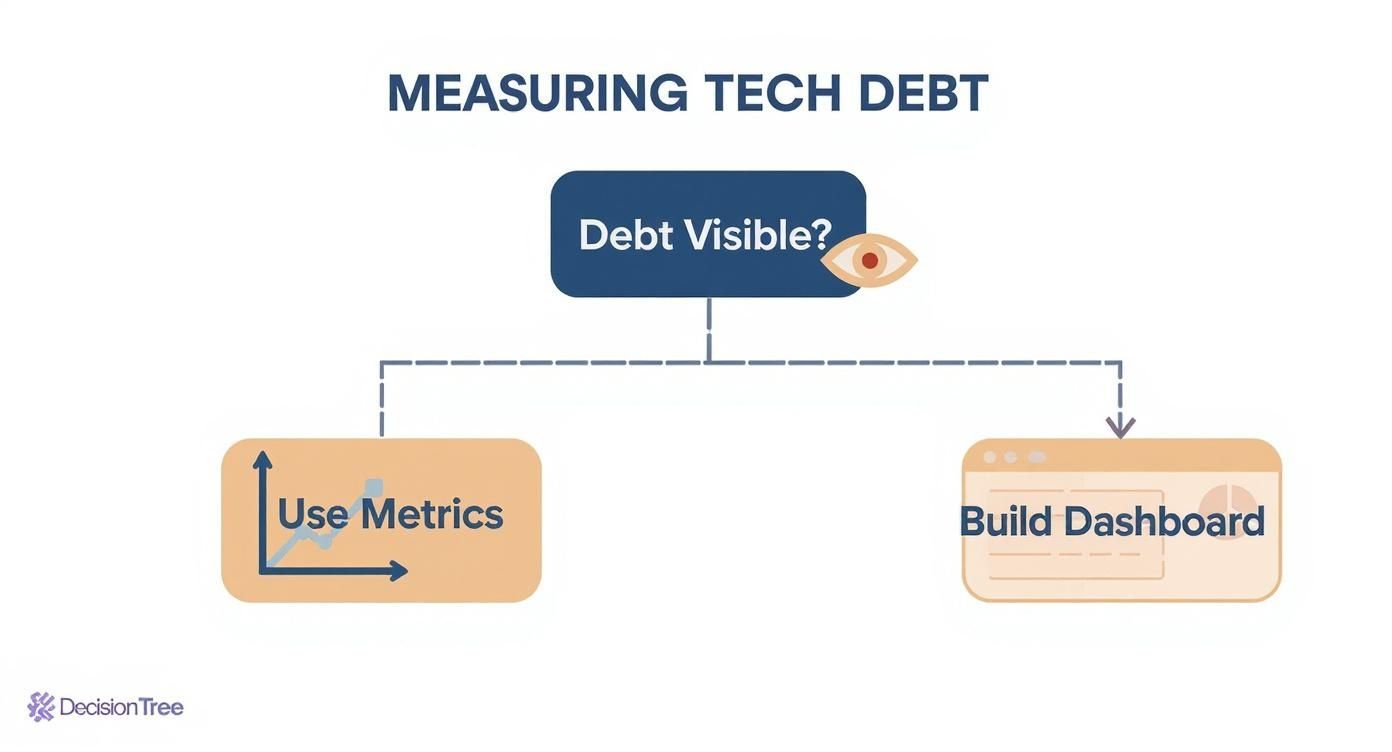
Without that foundational step of having clear metrics and a dashboard, any attempt to prioritize is just guesswork.
The teams that get this right don't just track code smells; they track the business pain those smells create. A flaky payment API is always a higher priority than a confusing admin interface, even if the admin code is technically a bigger disaster.
To put this into practice, you can use a simple matrix to categorize each piece of debt. This creates a clear action plan that everyone from engineers to product managers can understand.
Tech Debt Prioritization Matrix
This simple grid is your best friend for turning a messy backlog into a strategic plan. It helps you quickly sort issues into four actionable buckets based on the value they deliver versus the time they'll consume.
| Priority Level | Business Impact | Engineering Effort | Action & Example |
|---|---|---|---|
| Quick Wins | High | Low | Fix Immediately. These are your no-brainers. Think of patching a security vulnerability in a library that touches your user authentication flow. |
| Major Projects | High | High | Schedule Strategically. These require planning and budget. A good example is breaking apart a monolithic service that’s a bottleneck for three different teams. |
| Fill-in Tasks | Low | Low | Address When Possible. Perfect for new hires or between big projects. This is your classic "refactor a poorly named set of variables" task. |
| Ignore for Now | Low | High | Actively De-prioritize. The ROI just isn't there. Don't touch the old, stable reporting tool that only two people use once a quarter. |
Using this matrix turns your technical debt backlog from an overwhelming list into an actionable roadmap. You build momentum with the Quick Wins, which demonstrates immediate value and helps you get buy-in for tackling the bigger, more complex Major Projects.
Most importantly, it ensures every hour your team spends to reduce tech debt is an hour invested wisely.
Embedding Quality to Prevent Future Technical Debt
Fixing existing problems is a reactive game. To really get ahead of technical debt, you have to stop the bleeding. That means shifting your team's mindset from cleanup sprints to building a culture of quality where debt is prevented before it's even written.
This isn't about adding bureaucracy. It's about embedding smart, lightweight processes into your daily workflow, making quality the path of least resistance. The goal is to empower developers to build better code from the start without slowing them down.
Fortify Your First Line of Defense: Code Reviews
Code reviews are your single most effective tool for preventing new debt. But a vague "looks good to me" is worse than useless—it creates a false sense of security. To make reviews count, they need to be structured, rigorous, and focused on more than just catching typos.
A great way to start is by creating a formal code review checklist and adding it to your pull request template. This simple step ensures every reviewer is checking for the same critical quality attributes.
Your checklist should include prompts like:
- Clarity and Readability: Is the code easy to understand without a novel of comments? Are variable names meaningful?
- Test Coverage: Does this change include new or updated automated tests? Is the coverage adequate for the risk level of the code?
- Architectural Alignment: Does this code stick to established design patterns? Does it introduce any new, unapproved dependencies?
- Performance and Scalability: Are there any obvious performance bottlenecks, like N+1 queries or inefficient loops?
This simple act of standardizing reviews elevates the entire conversation. It moves the focus from subjective opinions to objective quality criteria, making it easier to have productive discussions about potential debt.
Building a culture of quality means making it harder to do the wrong thing than the right thing. Your processes should guide developers toward clean, maintainable code, not punish them for mistakes.
To truly embed quality, teams also need to get serious about mastering software defect tracking. This ensures that when issues do slip through, they're handled systematically instead of falling through the cracks.
Automate Quality Gates in Your CI Pipeline
Human oversight is essential, but it doesn't scale. Your CI/CD pipeline is the perfect place to automate quality checks, acting as an impartial gatekeeper that prevents subpar code from ever reaching production.
Think of it as your automated QA engineer. You can configure your pipeline to automatically fail a build if certain quality thresholds aren't met. This creates a hard stop that forces developers to address issues immediately.
Some effective automated gates include:
- Enforcing Test Coverage Thresholds: Set a minimum code coverage percentage (e.g., 80%) that every commit must meet. If a change drops the coverage below that line, the build fails. Simple as that.
- Static Code Analysis: Integrate tools like SonarQube or other linters directly into your pipeline. They can automatically detect code smells, potential bugs, and security vulnerabilities, flagging them before the code is ever merged.
- Dependency Scanning: Use automated tools to scan for known vulnerabilities in your third-party libraries. This is a non-negotiable step to prevent you from unknowingly inheriting security debt.
Automation takes the emotion out of quality enforcement. It’s not a manager nagging a developer; it’s just the system enforcing the standards the team already agreed upon.
Enhance Developer Workflows with In-IDE Analysis
The most efficient place to fix a problem is at the source—the developer's editor. Modern workflows are increasingly built around real-time analysis tools that give instant feedback right inside the IDE.
This is exactly what tools like kluster.ai are designed for. They offer in-IDE AI verification that catches issues as code is being written. By analyzing code against your repository's history, security policies, and even the developer's original intent, these tools can flag potential hallucinations, logic errors, and performance issues in seconds.
That tight feedback loop is incredibly powerful. It stops debt before it even becomes part of a commit.
When developers get instant feedback, they learn faster and produce cleaner code from the outset, which dramatically reduces the amount of rework needed downstream. For a deeper dive into how these practices fit into a larger strategy, our guide on software development best practices offers some valuable insights.
Integrating Tech Debt Work into Your Agile Sprints

Talking about technical debt is one thing; actually paying it down is another. We've all seen it happen. Well-intentioned teams create tech debt stories that get perpetually stuck at the bottom of the backlog, always out-prioritized by the next "urgent" feature.
The only way to break this cycle is to stop treating debt repayment as an occasional, heroic effort. Instead, you need to embed it as a consistent, predictable part of your development rhythm. The goal is to make small, regular payments on your debt, preventing it from spiraling into a crisis that requires a multi-month "cleanup" project no one wants to sign off on.
Allocating a Fixed Percentage of Sprint Capacity
One of the most effective strategies I've seen is to formally allocate a fixed percentage of every sprint's capacity to technical debt. It’s often called the "20% rule," but the number isn't magic. A team wrestling with a legacy system might need to set aside 30%, while a team with a healthier codebase could get by with just 10%.
The beauty of this approach is its simplicity and predictability. Product owners can plan their feature roadmaps with this allocation already baked in, which eliminates the constant negotiation each sprint. It completely changes the conversation from if we should address debt to which debt we should tackle with our allocated time.
This isn't just a niche practice, either. Industry data shows that companies are dedicating, on average, 20% of their resources to managing tech debt. It's a clear signal that setting aside capacity isn't just a good idea—it's becoming a standard cost of doing business.
Adopting the Boy Scout Rule
Another powerful, complementary approach is the "Boy Scout Rule": always leave the code cleaner than you found it. This simple philosophy empowers individual developers to make small, incremental improvements as they work on their regular feature tasks.
This doesn't mean creating a massive refactoring ticket. Instead, a developer might just:
- Improve the clarity of variable names in a function they're already modifying.
- Add a few missing unit tests to a module they're touching.
- Break down a complex method into smaller, more manageable pieces.
These small acts of continuous improvement prevent new debt from accumulating and slowly chip away at existing issues. When the entire team adopts this mindset, the cumulative effect over time is massive, all without needing large, dedicated blocks of time.
Writing Effective Tech Debt Stories
Simply allocating time isn't enough. You have to treat debt work with the same seriousness as feature work, and that means writing clear, well-defined user stories. A vague ticket like "Fix the checkout process" is guaranteed to be de-prioritized.
A strong tech debt story connects the technical problem to a tangible business outcome. It has to articulate the why.
Bad Story: "Refactor the Payment Service."
Good Story: "Refactor the Payment Service to reduce bug-related support tickets. Goal: Decrease payment failure tickets by 25% and speed up the development of new payment options by 40%."
By framing the work in terms of business impact, you help the product owner understand its real value. Suddenly, it's not just a technical chore; it's an investment in speed and stability. For more on structuring development efforts effectively, check out a practical guide to agile project planning.
This framing is essential for getting the consistent buy-in needed to reduce tech debt sprint after sprint. Making this a habit also improves your team's overall process; for more ideas, check out our guide on the best practices for code review.
Making the Business Case for Reducing Tech Debt
Engineers can smell technical debt from a mile away. We know when a feature takes twice as long as it should or when a simple bug fix causes a cascade of unrelated problems. The real challenge isn't identifying the debt; it's convincing leadership to give you the resources to fix it.
This is where most teams get stuck. They talk about "code complexity" and "refactoring," and all the business side hears is, "we want to stop building features and clean up old stuff." To get buy-in, you have to completely reframe the conversation.
Stop talking about engineering chores. Start talking about business outcomes. Your job is to translate abstract technical problems into the language of revenue, risk, and growth.
Connecting Technical Problems to Business Value
You need to draw a straight line from a specific piece of tech debt to a metric the business actually cares about. Vague complaints about a "messy codebase" won't get you a budget. You have to connect the dots.
Here’s how you can frame the argument to make an impact:
- Faster Feature Delivery: Instead of saying, "Our monolith is hard to work with," try this: "If we spend three sprints separating our payment service from the main application, we can launch new payment options 40% faster. That means we can beat competitors to new markets."
- Reduced Customer Churn: Don't just say "we have poor test coverage." Show the consequences: "By investing two sprints to improve test automation in our checkout flow, we can cut critical production bugs by 50%. That directly reduces support tickets and improves customer retention."
- Lower Operational Costs: Frame infrastructure debt in dollars and cents. For example: "Migrating our legacy database will cut our monthly hosting costs by $5,000 and decrease page load times, which will boost our conversion rate."
This approach changes everything. You’re no longer asking for time to clean up code. You’re proposing a project with a clear, measurable business benefit.
Highlighting the Scale of the Problem
Sometimes, a little outside perspective helps. Leaders need to see that this isn't just an internal engineering complaint; it's a massive, industry-wide liability that stifles innovation.
A 2025 report from HFS Research is pretty sobering on this front. They estimate that the world's top companies are sitting on $1.5 to $2 trillion in accumulated technical debt. It's a staggering figure that represents a real threat to their ability to compete. Worse, only 30% of large organizations are making any real progress in paying it down. You can read the full research about tech debt's global impact for yourself.
By presenting a clear ROI and putting the risk into context, you shift the conversation. Tech debt stops being a cost center and becomes a strategic imperative—an investment in your company's ability to innovate, scale, and respond to a changing market.
When you successfully make this case, you’re not just getting a one-off project approved. You’re building a shared understanding across the organization: that you must proactively manage and reduce tech debt to ensure long-term success.
Frequently Asked Questions About Reducing Tech Debt
When teams finally decide to tackle tech debt, a few common questions always seem to pop up. Let's walk through them.
One of the biggest is the classic debate: should we refactor this legacy system or just rewrite the whole thing from scratch? A total rewrite is tempting—a clean slate sounds great—but it’s almost never the right call. Unless the core technology is completely obsolete or the business has pivoted so hard the original code is irrelevant, a full rewrite is a massive, risky bet. Incremental refactoring is safer, delivers value along the way, and doesn't halt all other progress.
Another hurdle is getting product managers on board. How do you justify spending a sprint on something that doesn't ship a new feature? You have to speak their language. Frame it in terms of business impact. "Refactoring the user service" is just technical jargon. Instead, try explaining that the work will "cut user-related bug reports by 30%" or "let us build new features in this module 50% faster."
When you can clearly connect debt repayment to improved velocity, stability, or customer satisfaction, it stops being a technical chore and becomes a strategic investment everyone can get behind.
Ready to stop tech debt before it starts? kluster.ai provides real-time AI code verification directly in your IDE, catching errors and enforcing standards as you code. Start free or book a demo.