

Ai Pair Programmer: Accelerate Coding with ai pair programmer
An AI pair programmer is like having a seasoned coding partner sitting next to you, available 24/7 right inside your editor. It's an intelligent assistant that helps with the grunt work—cranking out routine code, suggesting complex algorithms, and even hunting down bugs—fundamentally changing how we build software.
Meet Your New AI Coding Partner
Think of an AI pair programmer as a hyper-aware assistant that lives inside your Integrated Development Environment (IDE). It’s not just a fancy autocomplete. It’s a genuine collaborator that tries to understand what you’re trying to build and helps you get there faster.
For years, tools like GitHub Copilot paved the way by offering smart, line-by-line suggestions. But a true AI pair programmer takes this a massive leap forward. Instead of just finishing a line of code, it can scaffold entire features, refactor messy functions, or write a whole suite of unit tests from a simple natural language prompt. This frees you up from the tedious, repetitive tasks so you can focus on the big picture—architecture, user experience, and creative problem-solving.
The Real Impact on Productivity
The biggest reason teams are adopting these tools is the immediate boost in speed. In a world where software needs to be shipped yesterday, AI pair programmers have become a massive advantage, cutting down the time spent on routine tasks by 30-50%, according to recent analyses. This isn't just hype; developers using tools in IDEs like VS Code and Cursor are seeing real-time feedback that catches mistakes before they spiral out of control. You can dig into more of the numbers in this report on the growth of AI coding assistants.
But that speed comes with a huge catch. The code these AIs generate isn't foolproof. Not even close. It can introduce subtle bugs, security holes, or logical flaws that are incredibly difficult to spot with the naked eye. This is why real-time verification and governance aren't just nice-to-haves; they're absolutely essential.
An AI pair programmer is a force multiplier for a developer's skills. It automates the tedious parts of coding, but its output must be guided and validated by human expertise to ensure quality and security.
A good AI pair programmer isn't just a code generator. It has to be part of a larger ecosystem that includes smart governance. Without a system in place to verify the AI’s work as it's being written, teams are just trading speed for stability—a deal that never pays off in the long run. The most successful teams pair these powerful assistants with solutions that review code on the fly, making sure every suggestion aligns with project standards and is safe to ship.
To put it simply, an AI pair programmer takes on several key jobs that were once entirely on the developer's shoulders. Here’s a quick breakdown of what they actually do.
Core Functions of an AI Pair Programmer
| Function | Description | Impact on Development |
|---|---|---|
| Code Generation | Creates code snippets, functions, or entire files based on natural language prompts or existing code context. | Reduces time spent on writing boilerplate and repetitive logic, accelerating feature development. |
| Code Completion | Intelligently suggests the next lines of code as you type, understanding the broader context of your file. | Speeds up the coding process and minimizes syntax errors and typos. |
| Refactoring | Analyzes existing code and suggests improvements for readability, performance, or maintainability. | Helps clean up technical debt and improves overall codebase quality without manual effort. |
| Debugging Assistance | Helps identify the root cause of bugs by analyzing error messages and suggesting potential fixes. | Shortens the debugging cycle by quickly pinpointing issues and offering solutions. |
| Test Generation | Automatically writes unit tests, integration tests, or end-to-end tests for your functions and components. | Improves code coverage and reliability, ensuring new features don't break existing ones. |
Ultimately, these tools are designed to handle the machine-like parts of coding, freeing up human developers to focus on the creative, strategic, and architectural decisions that AI can't make.
How AI Pair Programmers Actually Work
Let's get one thing straight: AI pair programmers aren't "thinking" like a human developer. Not even close. What’s happening under the hood is a sophisticated dance of deep learning, powered by technologies like Large Language Models (LLMs).
Think of these models as the ultimate code archivists. They’ve been trained on billions of lines of code scraped from public repos, open-source projects, and countless tutorials. It’s like they’ve read every programming book ever written, in every language. They don't just memorize syntax; they absorb the patterns, the relationships between code structures, and the idiomatic ways developers solve common problems. This massive dataset is what allows them to predict the next logical piece of code based on what you’ve already written.
This concept map gives you a high-level look at where these tools really shine: generating code, squashing bugs, and handling all that boilerplate you'd rather not write.
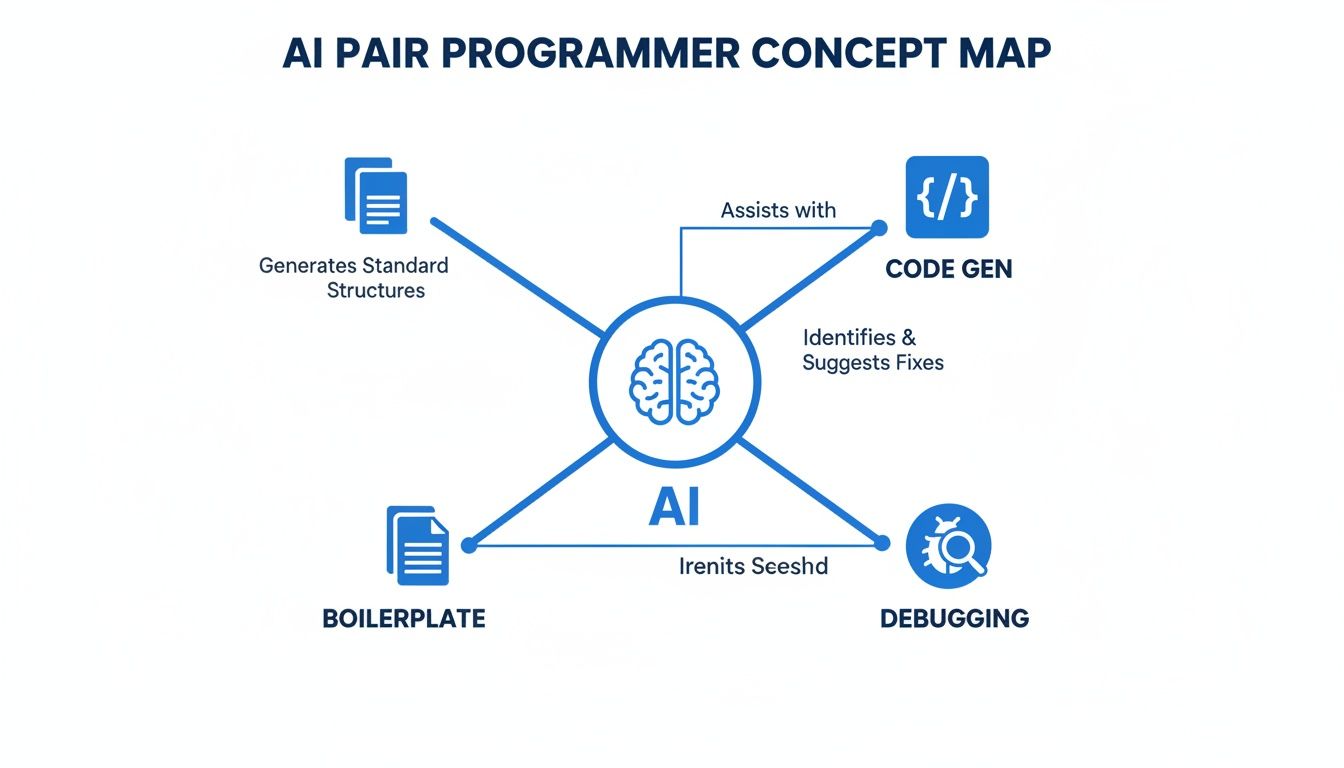
As you can see, their real value is in assisting across the entire development cycle, from the first line of a new feature to the final polish.
Understanding Context and Prompts
The magic of an AI pair programmer comes down to one thing: contextual awareness. It’s constantly reading your open files, looking at the libraries you've imported, and even analyzing your comments to figure out what you're trying to do.
When you drop in a comment like // Create a function to fetch user data from the API, the AI doesn't just see the text. It combines that prompt with the surrounding code to generate a function that actually fits. This is where prompt engineering becomes a developer's new superpower. A vague prompt gets you generic, often useless code. But a detailed one that specifies libraries, edge cases, and the desired outcome? That’s how you get code that’s shockingly accurate.
The quality of the code you get from an AI pair programmer is a direct reflection of the quality of the context and prompts you provide. Clear instructions lead to clear code.
The Inherent Risks of AI Generation
While the technology is impressive, this predictive process is far from perfect. AI models can, and often do, generate code that looks perfectly fine but is fundamentally broken. This phenomenon is often called "hallucination."
Because the AI is just a world-class pattern-matcher, it can confidently spit out code with subtle logic errors, gaping security holes, or behavior that completely misses the mark for your specific project. These problems crop up because the model has no real understanding of your goals. It’s not a mind-reader.
This gap between generating code and verifying its correctness is the single biggest challenge in using an ai pair programmer safely. It makes a rock-solid review and verification process absolutely non-negotiable for any team that's serious about their codebase.
Weighing the Benefits and Risks of AI Coding
Bringing an AI pair programmer onto your team is a huge shift. It's not just another tool; it introduces a completely new dynamic, packed with a compelling mix of speed and unforeseen challenges. For any engineering leader, getting this balance right is the key to boosting productivity without letting quality or security fall by the wayside.
The most obvious win is a massive injection of speed. These AI assistants chew through the tedious stuff—boilerplate code, unit tests, basic refactoring—freeing up your developers to wrestle with the hard problems, like system architecture and real innovation. That’s not just a small bump; it’s a direct line to faster development cycles and getting products out the door quicker.
It also dramatically lowers the cognitive load. Instead of constantly breaking focus to look up syntax or find the right library function, a developer can stay in the zone, simply asking the AI for a hand when they need it. This is a game-changer for junior engineers, who can learn your team's established patterns and best practices just by watching and interacting with the AI's suggestions.
Balancing Speed with Security
But all that speed comes with some serious risks you just can't ignore. The code an AI pair programmer spits out might look good and even run, but it can hide some nasty, subtle flaws.
- Security Vulnerabilities: AI models are often trained on oceans of public code, and they can easily replicate insecure patterns they’ve seen before. Think SQL injection or cross-site scripting vulnerabilities baked right into the generated code.
- Hard-to-Find Bugs: The AI can create code with bizarre logical errors or edge-case failures that sail through basic tests, only to blow up in production. These "hallucinations" can be absolute nightmares to track down and debug. You can learn more about tackling these problems in our guide on fixing AI-generated code issues.
- Over-Reliance and Skill Atrophy: If a team gets too comfortable letting the AI do the thinking, their own code review skills can start to fade. They might lose a deep, intuitive understanding of the codebase they're supposed to own.
The real challenge isn't just about generating code faster. It's about making sure that code is secure, correct, and actually aligns with your team's unique standards and the project's goals.
To get a clearer picture of what you're signing up for, it helps to lay out the trade-offs side-by-side.
AI Pair Programmer Adoption Benefits vs Risks
| Area of Impact | Potential Benefits | Potential Risks |
|---|---|---|
| Productivity | Drastically accelerates code generation, test writing, and refactoring, leading to faster sprint velocity. | Developers may become over-reliant on the AI, causing a decline in critical thinking and problem-solving skills. |
| Code Quality | Helps enforce consistent coding styles and can suggest optimizations or best practices. | AI can introduce subtle bugs, logical errors, or "hallucinations" that are difficult to spot in code reviews. |
| Security | Can be trained to identify and avoid common vulnerabilities if configured properly. | Models trained on public data may replicate insecure coding patterns, introducing new vulnerabilities. |
| Onboarding | Acts as an instant mentor for junior developers, helping them learn the codebase and established patterns. | Junior developers may learn to depend on AI suggestions without understanding the underlying principles. |
| Innovation | Frees up senior developers from mundane tasks to focus on complex architectural and product challenges. | A "good enough" AI solution might stifle creative problem-solving or exploration of more optimal, human-devised solutions. |
Ultimately, adopting an AI coding assistant is a strategic decision that requires a proactive approach to governance. It’s not just a tool to turn on and forget about.
The financial and operational impact is just too big to ignore. AI pair programming is fundamentally changing developer productivity, with tools already saving professionals 15 to 25 hours per month. That translates to an incredible $2,000 to $5,000 in annual value per developer, according to 2026 statistics.
This is where platforms like Kluster.ai come in. We amplify these benefits by running AI code reviews directly in the IDE, verifying that the generated output matches the original prompt. This catches logic errors, regressions, and security issues before the code ever leaves the developer's editor—a perfect fit for DevSecOps teams looking to prevent vulnerabilities at scale. You can dig into more insights on developer productivity trends on keyholesoftware.com.
By carefully weighing these pros and cons, your team can build a strategy that reaps the rewards of AI assistance while actively managing its inherent risks.
Blending Human and AI Collaboration
The arrival of AI pair programmers doesn't mean human developers are on their way out. Far from it. This is the next evolution of how we build software, creating a powerful hybrid where human creativity and AI's raw efficiency come together.
This partnership just works. Each side brings something unique to the table. Humans are still completely irreplaceable when it comes to seeing the big picture—thinking through system architecture, solving truly novel problems, and mentoring junior devs. Our intuition and grasp of the business context are things an AI simply can't touch.
The AI, on the other hand, operates with incredible speed and precision on well-defined tasks. It's brilliant at spotting code patterns, spitting out boilerplate, and handling routine, repetitive work without ever making a typo. This dynamic creates a natural and powerful division of labor.
The Strategic Human and the Tactical AI
The smartest development teams are already figuring this out. They treat the AI like a hyper-competent intern, delegating the tactical "what" and "how" of day-to-day coding. The AI writes the function, refactors the module, or generates the unit tests based on clear instructions.
This frees up human developers to focus on the strategic "why." Suddenly, they have more time for the high-impact work that drives real value—architectural decisions, user experience design, and wrestling with complex, thorny problems. It elevates the developer's role from a writer of code to an editor and strategist.
The goal isn't just to write code faster. It's to build a workflow where the AI handles the mundane, empowering developers to apply their expertise to challenges that require genuine insight and judgment.
This collaborative model is quickly becoming the new normal. The shift to AI pair programmers is a fundamental change in how we interact with technology, with intelligent agents acting as true digital partners. They generate the code while developers guide the overall strategy. This trend is backed by hard numbers, with the AI Coding Assistants market projected to grow exponentially alongside the broader GenAI explosion.
By blending the strengths of both human and machine, teams can hit a level of productivity and quality that neither could ever achieve alone. This synergy isn't just a nice-to-have; it's the future of modern software development.
Implementing AI Governance in Your Workflow
Giving your team an AI pair programmer without any guardrails is like handing over the keys to a supercar without a single driving lesson. It’s incredibly powerful, but you need a smart governance strategy to unlock its full potential without crashing.
This isn't about slowing things down with red tape. It’s about building a simple framework where speed, quality, and security can all live together.
The first move is to set up clear, practical guidelines for how to use the tool. Your developers need to know the rules of the road—when to trust an AI suggestion, when to be skeptical, and exactly how to verify the code it spits out. For a deeper dive into building a solid framework, you can check out these AI governance principles.
These guidelines are your foundation. But they only work if you pair them with a culture of critical review. Every single AI suggestion should be treated like a proposal from a very fast, but very inexperienced, junior developer. It needs a sign-off from someone who knows what they're doing.
Fostering a Culture of Critical Review
Just telling developers to "be careful" is a recipe for disaster. A real review culture is built on specific habits that become second nature.
- Human Oversight is Non-Negotiable: Every piece of AI-generated code, no matter how trivial it seems, must be reviewed by a human developer before it gets committed. The AI is a tool, not the final decision-maker.
- Encourage Questions: You have to create an environment where developers feel safe challenging the AI's output. Get them in the habit of asking "why" the AI chose a specific solution and whether a better one exists.
- Focus on Intent, Not Just Syntax: A good code review goes way beyond checking for syntax errors. It validates that the code actually does what the developer wanted it to do and doesn't introduce any sneaky side effects.
The key to successful agentic AI is creating a feedback cycle that doesn’t involve a human’s response. However, until that loop is perfect, human governance remains the ultimate backstop for quality and security.
Integrating Automated Governance In-IDE
Let's be realistic: manual reviews are essential, but they can't catch everything. More importantly, they can't operate at the speed of AI. This is where a real-time governance layer becomes a game-changer.
By building automated checks directly into the developer's IDE, you can enforce security policies and coding standards right at the source, before bad code is even written.
Tools like Kluster.ai act as this governance layer, creating an instant verification loop inside the editor. It analyzes AI-generated code against your team's specific rules, your security policies, and even the developer's original prompt. This process catches hallucinations, security flaws, and code that drifts from your standards in seconds.
This approach flips governance on its head. Instead of being a slow, after-the-fact process that everyone dreads, it becomes an immediate, preventative safety net that helps your ai pair programmer operate safely and effectively.
Using Kluster AI for Real-Time Code Verification
The sheer speed of an AI pair programmer is its biggest selling point, but it also creates a massive headache: how can you possibly trust the code it pumps out? Sticking with the old pull request review process just doesn't work—it's too slow and completely kills the momentum you were trying to gain.
The only real solution is to shift verification all the way to the left, embedding it directly into the developer’s workflow with real-time analysis right inside the IDE.
This is exactly where Kluster.ai comes in. Think of it as an essential governance layer that sits right alongside your AI assistant. It's not just another linter checking for syntax; it's an intent-driven verification engine. Kluster looks at the developer's original prompt and the surrounding project context to figure out the goal behind the code being generated.
Here's how Kluster.ai gives you instant verification right where you work, locking down code quality and security from the get-go.

This immediate feedback loop is absolutely critical for catching the kinds of subtle problems that usually go unnoticed until they’re causing chaos much later.
Catching Flaws Before They’re Even Committed
By living inside the editor, Kluster catches problems the instant they appear. It flags issues in seconds, giving developers immediate feedback so they can correct course without ever breaking their flow.
The core idea is simple: the best time to fix a bug is before it’s ever written. By checking code against the developer’s intent, Kluster makes sure the AI's output isn't just syntactically correct, but actually does what it's supposed to do.
This approach is incredibly effective at sniffing out the most common issues plaguing AI-generated code:
- Code Hallucinations: When the AI generates code that looks right but is riddled with subtle logic flaws or calls to functions that don't exist.
- Security Vulnerabilities: It actively scans for common insecure patterns that AI models often pick up and replicate from their vast training data.
- Alignment Drifts: It confirms the final code actually delivers on the requirements from the initial prompt, stopping you from wasting time on code that misses the mark.
For engineering teams, this transforms the ai pair programmer from a powerful but unpredictable tool into a reliable, governed assistant. The frustrating back-and-forth of endless code review cycles gets cut down dramatically. If you want to dive deeper, check out our post on why real-time AI code review is harder than you think.
Ultimately, this gives developers the freedom to merge with confidence, knowing every single line of AI-generated code has been validated against their intent and the team's standards. The result is a faster, smoother workflow that delivers trusted, production-ready code.
Common Questions About AI Pair Programmers
Whenever teams start talking about bringing in an AI pair programmer, the same handful of questions always pop up. It's only natural. Getting these answers straight is key to figuring out where this tool fits and setting the right expectations for your developers.
The big one on everyone's mind is usually about job security.
Can an AI Replace a Senior Developer?
No. Full stop. An AI pair programmer is a phenomenal assistant, but it's not a replacement. Think of it as a force multiplier.
It’s brilliant at churning out boilerplate, suggesting common patterns, and knocking out routine coding tasks in seconds. What it can't do is replace the deep, nuanced understanding a senior developer brings to the table. It has zero architectural foresight, no real business context, and it certainly can't mentor a junior engineer.
The best-case scenario is a powerful partnership: the AI handles the tactical, line-by-line coding, freeing up your senior devs to focus on system design, complex problem-solving, and leading the team. It’s an amplifier, not a substitute.
How Do You Prevent Security Vulnerabilities?
This is a huge one, and it requires a mix of culture and tooling. First off, you have to build a culture where developers treat AI suggestions with healthy skepticism. Blindly accepting code is a recipe for disaster.
But culture alone isn't enough. You need technical guardrails.
The most effective strategy is implementing a real-time verification layer that works inside the IDE. This provides an essential guardrail that traditional tools miss in the earliest stages of code generation.
An in-IDE check like this automatically scans AI-generated code against your security policies and known vulnerability patterns before it ever gets committed. It catches issues right at the source, which is exactly where you want to stop them.
Will It Weaken a Junior Developer's Skills?
It’s a fair question, but the answer is just the opposite—if you use it the right way. An AI assistant can be an incredible learning accelerator for junior developers.
The key is teaching them to use it as a guide, not a crutch. They should be encouraged to question why the AI suggested a certain solution, not just copy-paste it. What’s the pattern here? Is there a better way?
When you pair that curiosity with a governance tool that enforces your team's specific coding standards, the AI becomes a personalized tutor. It helps them learn best practices and discover new approaches, all while making sure they stick to your quality standards from their very first day.
Ready to secure your AI-driven development pipeline? With kluster.ai, you can implement real-time governance directly in your IDE, ensuring every line of AI-generated code is secure, correct, and aligned with your standards. Learn how to ship faster with confidence.