

Mastering agile vs devops: Key differences and practical guidance
Let's get one thing straight: the whole "Agile vs. DevOps" debate is a bit of a red herring. The real difference is what part of the problem they solve. Agile is all about optimizing how we create software.Think of it like this: Agile asks, "Are we building the right thing?" through short, iterative cycles. DevOps, on the other hand, asks, "Are we building the thing right?" by automating the entire delivery pipeline for speed and stability.
Understanding Where They Came From
To really get the difference, you have to realize they aren't competitors. They're complementary pieces of the same puzzle, born from different frustrations in the software world.
Agile was a reaction against rigid, old-school development models like Waterfall. Its whole reason for being is to inject flexibility and customer feedback directly into the building process. The core ideas are pretty simple:
- Iterative Development: You break work into small, manageable chunks called sprints. This lets teams build, test, and get feedback on the fly instead of waiting until the very end.
- Customer Focus: It’s built around a constant feedback loop to make sure the final product is what users actually want. Plans change, and that's okay.
- Team Collaboration: It relies on tight communication within small, cross-functional teams who have everything they need to get the job done.
DevOps came later. It’s a cultural and engineering practice designed to tear down the wall between software development (Dev) and IT operations (Ops). It tackles all the friction that happens after the code is written, focusing on automating the entire path to production.
DevOps doesn't replace Agile; it picks up where Agile leaves off. Agile gets you to "code complete," but DevOps takes that code and automates its journey all the way to the end-user.
This distinction is everything. An Agile team can churn out features at an incredible pace, but if getting those features deployed is a slow, manual, error-prone mess, then all that speed is wasted. DevOps fixes that "last-mile" problem.
Key Distinctions at a Glance
This table breaks down the core differences in a nutshell.
| Dimension | Agile | DevOps |
|---|---|---|
| Primary Focus | Efficiently creating software features | Reliably releasing and operating software |
| Core Problem Solved | The project management and development process | The deployment pipeline and operational stability |
| Main Goal | Adaptability and customer satisfaction | Speed, reliability, and automation |
| Scope | Pre-deployment (from idea to "done" code) | End-to-end (from developer to production) |
While Agile completely changed how we build software, DevOps is quickly becoming the standard for how we deliver it. The numbers don't lie: 49% of IT organizations now consider DevOps their primary process, with Agile just behind at 36%. And the impact is huge—an incredible 99% of organizations say DevOps has positively affected their operations, and 83% adopted it specifically to create more business value. If you want to dive deeper into the data, these DevOps statistics paint a pretty clear picture.
Comparing Core Principles and Goals
Even though Agile and DevOps are both aiming to get software out the door better and faster, they come at it from completely different angles. Getting this distinction right is key; they aren’t fighting for the same job but are instead focused on separate parts of the journey from idea to production.
Agile’s principles, laid out in the famous Agile Manifesto, are all about people, collaboration, and shipping software that actually works. It puts human interaction and responding to change front and center.
The main goal here is development velocity. That means reliably shipping valuable, working features that customers want, all done in short, repeatable cycles called sprints.
DevOps, on the other hand, is built on systems thinking. It’s about shared ownership, automating the entire delivery pipeline from end to end, and creating tight feedback loops that reach all the way into production.
Its ultimate goal is delivery velocity. This isn’t just about how fast you can deploy code, but also how stable and reliable that software is once it’s live. It’s about building a fast, safe, and repeatable path from a developer’s laptop to the end user.
You can really boil down the difference by looking at the core question each one tries to answer.
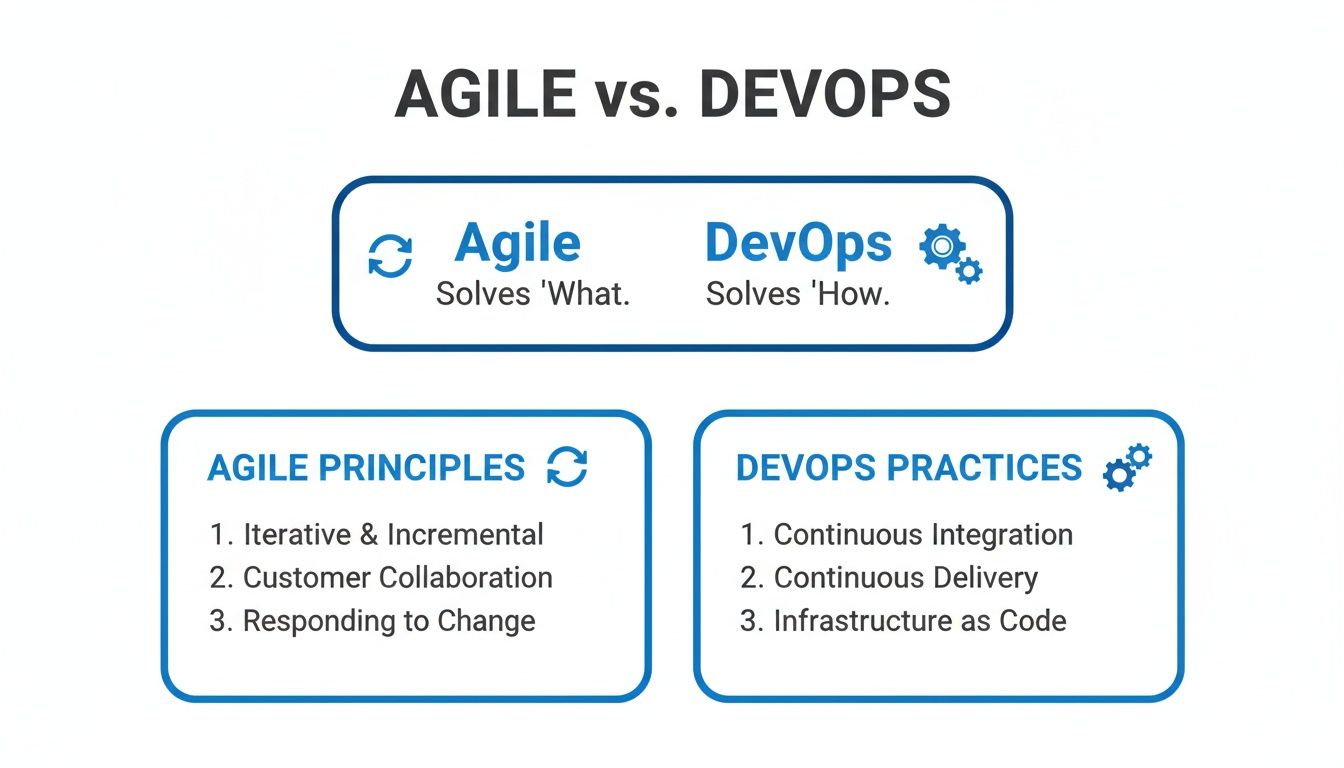
As the infographic shows, Agile is mostly solving for what to build by using iterative feedback. DevOps solves for how to deliver and run it efficiently and reliably.
To make this crystal clear, let's break down their principles in a simple table.
Agile vs DevOps Core Principles and Goals
| Dimension | Agile | DevOps |
|---|---|---|
| Primary Goal | Development Velocity: Build the right product quickly. | Delivery Velocity: Deliver the product quickly and safely. |
| Core Focus | Iterative development, customer feedback, and adapting to change. | End-to-end automation, system stability, and cross-team collaboration. |
| Scope | Primarily focused on the software development lifecycle (pre-deployment). | Spans the entire value stream, from development through operations and monitoring. |
| Key Question | "Are we building the right thing?" | "Can we release this reliably and run it well?" |
This side-by-side view highlights that they aren't competitors. Instead, they are complementary philosophies that address different bottlenecks in the software delivery process.
Agile Principles Unpacked
The Agile philosophy was born out of frustration with old-school, rigid models like Waterfall. Its principles are specifically designed to make the development process more human and responsive.
- Customer Collaboration Over Contract Negotiation: Agile is all about a constant conversation with stakeholders. Requirements are expected to evolve, and the entire process is built to handle that, making sure the final product is actually what people need.
- Working Software Over Comprehensive Documentation: The true measure of progress is functional software you can click on and test. Documentation has its place, but it never trumps delivering something tangible.
- Responding to Change Over Following a Plan: Agile teams see change as an opportunity, not a problem. They’re built to pivot fast when new information comes to light, without derailing the whole project.
These principles are laser-focused on optimizing the pre-deployment phase of creating software.
DevOps Principles In Focus
DevOps takes the collaborative fire started by Agile and spreads it beyond the dev team to include operations, security, and everyone else down the line. Its principles are engineered to tear down silos and automate the entire delivery lifecycle.
"DevOps is not a goal, but a never-ending process of continual improvement." – Jez Humble
This quote gets to the heart of DevOps. It’s a cultural commitment to constantly refine the entire system, guided by a few core ideas:
- End-to-End Ownership: The "you build it, you run it" mindset is everything. Teams are responsible for their code not just in development but also in production. This creates a powerful sense of accountability for performance and stability.
- Continuous Everything: This is where you hear about continuous integration (CI), continuous delivery/deployment (CD), and continuous monitoring. The objective is to make releases so routine and automated that they become low-risk, non-events.
- Systems Thinking: DevOps forces teams to look at the entire value pipeline. A bottleneck in the testing or deployment stage isn't "some other team's problem"—it's a systemic issue that everyone owns and works to fix.
By focusing on these principles, DevOps picks up right where Agile leaves off, optimizing for operational excellence and system-wide efficiency.
How Team Structures and Workflows Differ
The methodology you choose has a profound impact on a team's daily rhythm and operational life. When you compare Agile and DevOps, this is where the high-level philosophy gets real, shaping everything from meeting schedules to who is responsible for what. An Agile team, for instance, is built for one thing: focused, iterative creation.
These teams are typically small, cross-functional, and self-organizing. Think of a classic Scrum team—it's got developers, testers, a Product Owner who is the voice of the business, and a Scrum Master who keeps the process running smoothly. This small unit has every skill needed to take a feature from a rough idea to a "done" piece of code, all within a single sprint.
The workflow is predictable and cyclical, revolving around time-boxed sprints that usually last two to four weeks. This cadence is marked by specific ceremonies designed to keep up momentum and make sure everyone is on the same page.
The Agile Cadence: A Sprint in Motion
The Agile workflow creates a highly structured little world focused squarely on development productivity. Every sprint is basically its own mini-project with its own rituals:
- Sprint Planning: The team pulls work from the product backlog and commits to getting it done.
- Daily Stand-ups: A quick, daily check-in to talk about progress, blockers, and what’s next.
- Sprint Review: The team shows off what they built to stakeholders to get immediate feedback.
- Retrospective: The team looks back on the sprint to figure out how to do better next time.
This entire structure is laser-focused on the development loop. The team’s main job is to produce a potentially shippable piece of software by the end of the sprint. Once the code is handed off for deployment, however, their direct responsibility often ends.
DevOps, on the other hand, is all about tearing down the very silos that Agile teams often operate within. It’s not just about having one cross-functional team; it’s about creating deep, continuous collaboration between departments that have historically been kept separate—development, operations, security, and QA.
The biggest accountability shift from Agile to DevOps is going from a "we built it" attitude to a "we build it, we run it" ethos. This idea of shared ownership is the absolute foundation of DevOps.
This mental shift completely changes the team structure and workflow. Instead of passing work from one team to the next, the process becomes a continuous, automated pipeline. The workflow isn't defined by sprints but by the flow of value—from an idea all the way to production and back again through feedback.
The DevOps Flow: Continuous Delivery
A DevOps workflow is built around a CI/CD (Continuous Integration/Continuous Delivery) pipeline. This is an automated pathway that handles building, testing, and deploying code, turning releases into a routine, low-risk event. To support this, the team structure has to change.
Engineers are expected to have broader, "T-shaped" skills. This means they have deep expertise in one area (like development) but also a solid working knowledge of others (like infrastructure or monitoring). This allows a single team to own a service across its entire lifecycle.
Here’s a practical look at how these differences play out:
| Dimension | Agile Team Structure & Workflow | DevOps Team Structure & Workflow |
|---|---|---|
| Team Composition | Small, self-contained, cross-functional units (e.g., Scrum team). | Cross-departmental collaboration; teams organized around services or products. |
| Primary Workflow | Time-boxed sprints with defined ceremonies (planning, stand-ups, retrospectives). | A continuous, automated CI/CD pipeline for integration, delivery, and monitoring. |
| Accountability | Responsibility is primarily for delivering working software at the sprint's end. | End-to-end ownership of a service, from development to production performance and stability. |
| Skill Focus | Deep expertise in core development and testing roles within the team. | Broader, T-shaped skills combining development, operations, and security knowledge. |
At the end of the day, whether a company leans more toward Agile or DevOps, the goal is the same. Success hinges on building high-performing teams that can deliver and improve continuously. Agile gives you the framework to organize development work efficiently. DevOps takes that collaborative spirit and stretches it across the entire delivery lifecycle, creating a system that's far more resilient and responsive.
Analyzing Toolchains and Automation Approaches
The tools that teams gravitate towards say everything about their priorities. Look at the software supporting Agile and DevOps, and you'll see a clear dividing line: one side focuses on managing human collaboration, the other on automating technical processes.
An Agile toolchain is all about project management and team communication. It's built to bring clarity and order to the often-chaotic process of building software, answering questions like, "What are we building next?" and "Is this sprint actually on track?"
In contrast, the DevOps toolchain is far more technical, built almost entirely on automating the entire software delivery lifecycle from end to end.
Agile Tools for Collaboration and Visibility
Agile tooling is designed to make the development workflow visible and manageable for everyone involved. The entire point is to support the ceremonies and artifacts that frameworks like Scrum or Kanban depend on.
You'll typically see a few core categories of tools:
- Project and Issue Tracking: Platforms like Jira, Trello, and Asana are the command center for any Agile team. This is where you'll find the product backlog, sprint plans, and Kanban boards tracking user stories from "To Do" to "Done."
- Collaboration Hubs: Agile requires constant communication, which is why tools like Slack, Microsoft Teams, and Confluence are non-negotiable. They're used for everything from daily stand-ups and quick questions to sharing documentation.
- Whiteboarding and Ideation: Tools like Miro or FigJam have become essential for remote teams. They help replicate the experience of brainstorming on a physical whiteboard, mapping out user flows, and running retrospectives.
These tools are crucial for organizing the work before a single line of code gets pushed to a pipeline. They manage the human side of software creation, making sure everyone is aligned and pulling in the same direction.
An Agile toolchain optimizes for clarity in the development process. A DevOps toolchain optimizes for speed and reliability in the delivery process. One manages tasks, the other automates actions.
The DevOps Toolchain for End-to-End Automation
A DevOps toolchain isn't really a single platform but an interconnected web of automated systems that form a CI/CD pipeline. Its one and only job is to get committed code into production as fast and as safely as possible with minimal human friction.
This toolchain is assembled from several distinct, integrated parts:
- Source Code Management (SCM): Git is the undisputed standard, hosted on platforms like GitHub, GitLab, or Bitbucket. This is where all code lives and where collaboration truly begins.
- Continuous Integration/Continuous Delivery (CI/CD): This is the engine of DevOps. Tools like Jenkins, GitLab CI, and CircleCI automatically build, test, and prepare code for deployment every time a developer commits a change. To get this right, it's worth brushing up on the latest CI/CD best practices that drive modern development.
- Infrastructure as Code (IaC): Tools like Terraform and Ansible let teams define and manage their infrastructure with code. This is a game-changer, making environments repeatable, consistent, and easy to scale.
- Containerization and Orchestration: Docker packages applications into portable containers, and Kubernetes manages those containers at scale. This combination has become the de facto standard for deploying modern, resilient applications.
- Observability and Monitoring: Once the code is live, tools like Prometheus, Grafana, and Datadog give teams deep visibility into how their applications are performing. They close the feedback loop by flagging issues in real-time.
This screenshot from GitLab shows how a unified platform can bring many of these stages—from planning all the way to monitoring—into a single view.
By visualizing the whole lifecycle, these platforms reinforce the core DevOps principle of end-to-end ownership, breaking down the traditional walls between development and operations.
When you get right down to it, the toolchains tell the whole story. Agile tools help people work together to create great software. DevOps tools create an automated system that builds, tests, deploys, and runs that software, cutting out human error to maximize speed and reliability.
Measuring Success with the Right Metrics
Agile and DevOps measure success through completely different lenses. One is obsessed with development efficiency, the other with delivery reliability. Because they're optimizing for different outcomes, their Key Performance Indicators (KPIs) tell very different stories.
If you don't get this distinction right, you'll end up measuring the wrong things and chasing vanity metrics that don't align with your actual business goals.
Agile KPIs: How Well Are We Building?
An Agile team measures its success by its ability to predictably and efficiently build high-quality features. The metrics are introspective; they’re all about the health and productivity of the development process itself.
These KPIs give you a direct window into the team's internal workflow, helping them answer questions about their own productivity and predictability sprint over sprint.
- Velocity: This is the average amount of work a team gets done during a sprint, usually measured in story points. It’s not about speed—it’s about capacity. It's a crucial tool for planning future sprints realistically.
- Cycle Time: This tracks the clock from the moment a task is marked "in progress" to when it's "done." Short cycle times are a great sign of an efficient workflow with few bottlenecks.
- Lead Time: This is the bigger picture. It measures the total time from when a task is first created (sitting in the backlog) to when it’s finally completed. It reveals the efficiency of the entire process, including wait times.
- Burndown Chart: This is a simple visual that shows work remaining versus time left in a sprint. It’s the team’s gut check—are we on track or are we falling behind?
All these KPIs are about one thing: optimizing the creation of software. They help teams tighten up their internal processes, get better at estimating, and deliver a consistent chunk of work, sprint after sprint.
DevOps KPIs: How Well Are We Delivering?
DevOps couldn't care less about story points. It measures success based on the entire system's ability to deliver value to users—quickly and reliably. The focus shifts from internal team productivity to the health and performance of the whole delivery pipeline.
The gold standard here is the set of DORA metrics, developed by the DevOps Research and Assessment team at Google.
The core difference in measurement philosophy is stark. Agile KPIs ask, 'How efficiently are we building features?' DevOps KPIs ask, 'How quickly and reliably are we delivering value to users?'
The DORA metrics give you a balanced view of software delivery performance, making sure speed doesn’t come at the cost of stability.
- Deployment Frequency: How often do you successfully release to production? Elite performers aren't shipping once a sprint; they're deploying on-demand, multiple times a day.
- Lead Time for Changes: How long does it take for a code commit to actually make it into production? This is a key indicator of your entire pipeline's efficiency.
- Change Failure Rate: What percentage of your deployments cause a production failure that requires a hotfix or a rollback? A low number here is a sign of high quality and reliability.
- Mean Time to Restore Service (MTTR): When things inevitably break, how long does it take to fix them? A low MTTR shows your team can diagnose and resolve production issues without panic.
At the end of the day, these two sets of metrics aren't competing; they're complementary. A high-performing Agile team with great velocity and short cycle times provides the fuel—well-built features. A strong DevOps culture with excellent DORA scores provides the engine—an automated, reliable pipeline to get that value into customers' hands safely and at speed.
Integrating Agile and DevOps for Peak Performance
Smart organizations know the whole "Agile vs. DevOps" debate is a false choice. The real magic happens when you treat them as two sides of the same coin. You get a powerful engine for shipping value when your efficient Agile development process feeds directly into a slick, automated DevOps pipeline.

But this isn't just about hooking up some tools. It’s a genuine fusion of culture and operations. It all starts by taking Agile’s core ideas and stretching them beyond just the dev team to cover the entire lifecycle. The aim is a single, unified flow from a bright idea all the way to production, where everyone owns the outcome.
Building the Bridge with Automation
Automation is the glue that holds these two methodologies together. A classic, battle-tested pattern is to use the end of an Agile sprint to kick off a DevOps CI/CD pipeline. Once a sprint wraps and the team marks features as "done," that action should automatically trigger a chain of builds, tests, and deployments.
This keeps Agile’s iterative focus intact while bringing in the speed and rock-solid reliability of DevOps. The secret is making sure that handover is completely seamless.
The goal of integration is to make the transition from "code complete" in a sprint to "live in production" a non-event. It should be a routine, automated, and low-risk process, not a high-stress, manual handoff.
Getting to this point takes a serious commitment to shared goals and a culture of continuous improvement across every team that touches the software.
A Practical Roadmap for Integration
Fusing these two approaches doesn't happen by accident. It takes deliberate effort, and teams that succeed usually focus on a few key areas. For some, this means looking into advanced strategies like DevOps Integration Modernization to really sharpen their edge.
Here’s a practical roadmap to get you started:
-
Align Goals and Metrics: Make sure your dev and ops teams are chasing the same targets. Ditch the siloed metrics—where devs only care about sprint velocity and ops only cares about uptime. Instead, get both teams measured on shared outcomes like lead time for changes and change failure rate.
-
Extend Feedback Loops: Agile’s feedback loops, like sprint reviews and retrospectives, are great, but they usually stop before code hits production. A real integration pushes these loops all the way out. Use your monitoring and observability tools to pipe production performance data right back to the development team, so it can inform what you build in the very next sprint.
-
Embed Quality Early: Don't wait for the CI/CD pipeline to catch problems. This is all about "shifting left"—building quality and security checks directly into the development workflow itself. This is where modern tooling becomes absolutely critical.
For instance, in-IDE platforms like kluster.ai enforce your team's code quality and security standards as developers write the code. This means any code leaving an Agile sprint and entering the DevOps pipeline is already vetted, secure, and reliable. It’s a proactive move that dramatically speeds up delivery without compromising on stability and is a core strategy for anyone looking into how to improve developer productivity.
By weaving these practices together, your organization can finally move past the theoretical "Agile vs. DevOps" debate. You'll build a pragmatic, high-performance system that’s brilliant at both building the right thing and building the thing right.
Common Questions About Agile and DevOps
Look, the whole "Agile vs. DevOps" thing can get confusing. Let's clear up a few of the most common questions I hear all the time.
Is DevOps Just Agile 2.0?
Not at all. They’re solving different problems. Agile is a project management philosophy that helps teams build software in small, iterative chunks. It’s all about building the right thing.
DevOps, on the other hand, is about getting that software into the hands of users quickly and reliably. It's a cultural and engineering practice focused on automation and collaboration between development and operations. Think of it this way: Agile builds the car, and DevOps builds the automated highway to get it to the customer. They work together, but they aren't the same.
Can We Do Agile Without DevOps?
Absolutely, and many teams do. You can have a perfectly functioning Agile team using Scrum or Kanban to manage development sprints. They get really good at building software iteratively but might still hand off the finished code to a separate operations team for a traditional, manual deployment.
The problem? You create a bottleneck. The development team is moving fast, but the code just sits in a queue waiting to be released. This is where DevOps comes in. It breaks down that wall, letting the speed you gain from Agile actually translate into faster value for your users.
The real difference is scope. Agile focuses on the pre-deployment lifecycle—building the software. DevOps covers the entire lifecycle, from the first line of code all the way to production monitoring and back again.
How Big Are These Methodologies in the Real World?
They're not just buzzwords; they're the foundation of modern software delivery. The market for Agile and DevOps services is expected to climb to $25.1 billion by 2032, which tells you just how deeply embedded they are in the industry. We're even seeing new specializations pop up. For instance, about 90% of IT leaders now believe AIOps is essential for scaling their security and operations. You can dig into more of these market trends and future projections to see where things are headed.
Tired of AI-generated code creating bugs? kluster.ai enforces your quality and security standards right in the IDE, before code ever gets to a pull request. We catch hallucinations, stop regressions, and make sure every commit is ready for production. Start your free trial of kluster.ai today.